
GP vs. LP is one of the first distinctions every real estate investor should understand before evaluating a private deal. These two roles — General Partner and Limited Partner — define who runs the investment and who provides the capital, who carries the operational burden and who receives the passive returns, and who takes on personal liability and who is protected from it. In every real estate syndication, there is a GP and one or more LPs — and understanding how those roles differ is essential to evaluating whether a deal is structured fairly and whether you’re positioned to benefit from it.
What Is a General Partner (GP) in Real Estate?
A general partner (GP) in real estate is the operator, manager, and decision-maker in a private real estate investment — responsible for sourcing the deal, raising capital, executing the business plan, managing the asset, and ultimately delivering returns to investors.
The GP is also called the “sponsor” and, in syndication documents, the “general partner” or “managing member” of the LLC that holds the property. In a fund structure, the GP is the fund manager. In all cases, the GP is the active party: the one doing the work, taking on the liability, and controlling the investment.
Core responsibilities of the General Partner:
- Identifying and underwriting investment opportunities
- Negotiating purchase contracts and securing financing
- Raising equity capital from limited partner investors
- Executing the value-add business plan (renovations, operations, leasing)
- Overseeing asset management — property managers, vendors, financials
- Providing regular reporting and distributions to LPs
- Managing the sale or refinance of the asset at exit
The GP also bears unlimited personal liability for the obligations of the partnership (in a traditional general partnership structure) — which is why most modern real estate syndications are structured as limited liability companies (LLCs), where the GP is the “managing member” and their personal liability is limited by the LLC structure, though they often provide “bad boy” carve-out guarantees to lenders.
What Is a Limited Partner (LP) in Real Estate?
A limited partner (LP) in real estate is a passive investor who contributes equity capital to a deal and receives a pro-rata share of the returns — but has no role in day-to-day management decisions and bears liability only up to the amount of their investment.
LPs are the capital providers in a syndication. They fund the equity portion of the deal, receive distributions during the hold period, and share in the sale proceeds at exit — without the operational burden of managing the asset. In exchange for their passive role, LPs accept a ceiling on direct control: they cannot unilaterally direct the GP’s decisions, remove a property manager, or initiate a sale.
Core characteristics of the Limited Partner:
- Passive investor — no management role or day-to-day responsibilities
- Limited liability — maximum loss is limited to invested capital
- Receives a preferred return before the GP earns promoted interest
- Entitled to a pro-rata share of distributions and sale proceeds
- Receives regular financial reporting through the deal sponsor
- Must typically qualify as an accredited investor (or qualified purchaser for certain fund structures)
The LP structure is what makes passive real estate investing possible. An accredited investor with no real estate operating experience can invest alongside a professional operator — receiving institutional-quality returns without taking on the operational complexity that comes with direct ownership.
GP vs. LP: Side-by-Side Comparison
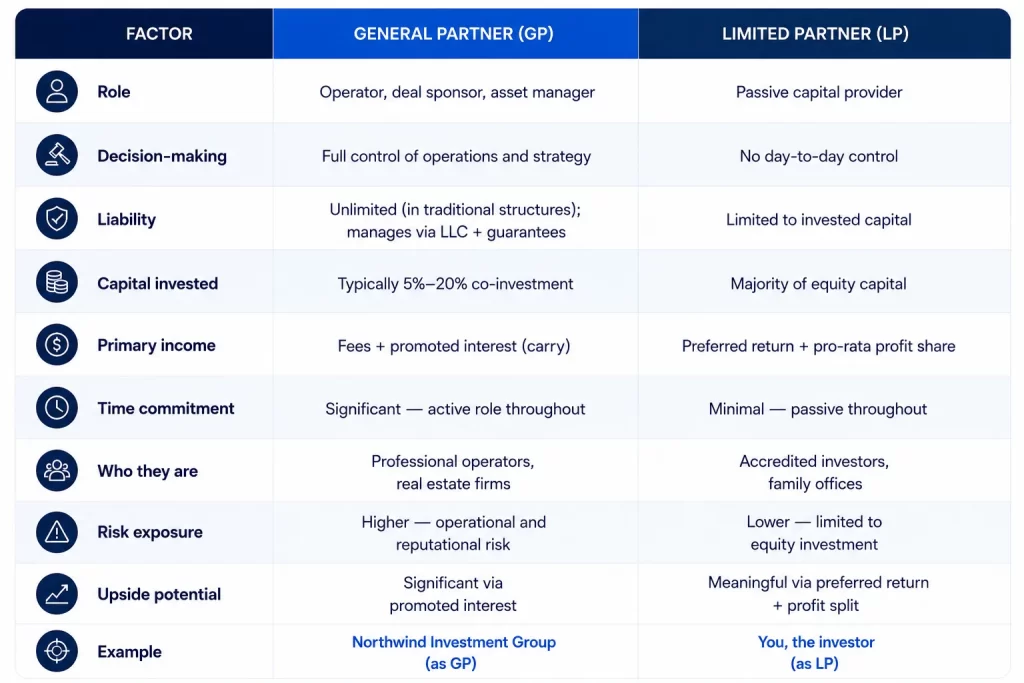
How General Partners Get Compensated
Understanding how a GP earns money is essential to evaluating whether their incentives are aligned with yours. GP compensation typically comes from several sources:
Acquisition fee (1%–2% of purchase price) A one-time fee paid at closing to compensate the GP for sourcing and underwriting the deal. On a $10M acquisition, this is $100,000–$200,000.
Asset management fee (1%–2% of equity or gross revenues annually) An ongoing fee for managing the investment — overseeing property operations, financials, investor communications, and strategic decisions. This is paid quarterly or annually throughout the hold period.
Disposition fee (0.5%–1% of sale price) A fee paid when the asset is sold, compensating the GP for managing the exit process. Not all sponsors charge this.
Promoted interest (carried interest / “the promote”) This is where the GP captures the majority of their upside. After LPs have received their preferred return and the return of their capital, the GP receives a disproportionate share of remaining profits — typically 20%–30% — relative to their invested capital. This is the most powerful alignment mechanism in a syndication: the GP only earns the promote if the deal performs well enough to clear the LP’s preferred return threshold first.
Example: If LPs receive an 8% preferred return and the deal ultimately generates a 2.0x MOIC and 16% IRR, the GP earns 20%–30% of the profits above the preferred return — even though they contributed only 10%–15% of the equity.
For a deeper look at how returns are calculated, see our guides to IRR in Real Estate and MOIC Explained.
How Limited Partners Get Compensated
LP compensation is structured around a priority-first model designed to protect investors before the GP profits.
Preferred return LPs typically receive a preferred return of 6%–8% annually before the GP earns any promoted interest. This is not a guaranteed return — it is a distribution priority. If the deal generates sufficient cash flow, LPs receive this distribution first. Unpaid preferred return typically accrues and is paid at sale if it was not fully covered during the hold period.
For more on how preferred return fits into the broader deal structure, see our article on preferred equity.
Return of capital At sale, LPs receive the full return of their invested equity before the GP participates in any remaining sale proceeds. This further protects LP capital before the promote kicks in.
Pro-rata profit share After the preferred return and return of capital, remaining profits are split between LPs and the GP per the waterfall — typically 70/30 or 80/20 in favor of LPs.
Understanding the waterfall The distribution waterfall defines the exact order and conditions under which money flows from the deal to each party. A standard waterfall in a value-add syndication might look like this:
- Return of LP capital
- 8% preferred return to LPs
- 50/50 catch-up to GP (until GP has received 20% of total profits)
- 80% LP / 20% GP split on all remaining proceeds
The capital stack and waterfall structure are the two most important documents to review before committing capital to any deal.
What LPs Should Evaluate Before Investing With Any GP
Not all GPs are created equal. Here are the questions every LP should ask before deploying capital:
Does the GP co-invest their own capital? A GP who invests their own money alongside LPs is demonstrating genuine conviction in the deal and creating direct financial alignment. Ask how much — a GP who co-invests 5%–10% of the equity is far more aligned than one who contributes nothing.
What is the GP’s track record? How many deals has the sponsor closed? What were the actual outcomes — not just projections? Have they returned capital to investors? Have they managed through a market downturn? Track record is the single most important due diligence criterion for passive investors evaluating a GP.
How transparent is the reporting? LPs should expect regular financial reporting — quarterly statements at minimum, including income, expenses, occupancy, capital expenditure updates, and distribution schedules. Sponsors who use institutional investor portals (such as InvestNext) provide real-time access to financials, documents, and deal updates.
What does the fee structure look like? Review all fees: acquisition, asset management, disposition, and any other charges. Excessive fees reduce LP returns and can signal a GP whose primary business is fee income rather than deal performance.
What are the exit rights and hold period? What is the projected hold period? Under what conditions can the GP extend it? Do LPs have any liquidity rights during the hold? What triggers a sale?
The Risk Asymmetry Between GPs and LPs
One often-overlooked dimension of the GP/LP structure is the asymmetry in downside risk. GPs and LPs face fundamentally different risk profiles:
LPs: Risk is limited to their invested capital. If the deal loses 30% of its value, LPs lose proportional equity — but their personal assets are protected. They cannot be called upon for additional capital beyond their initial commitment (unless they signed additional guarantee documents, which is rare in a properly structured syndication).
GPs: The risk exposure is broader. GPs carry reputational risk, operational risk, and often personal financial risk through “bad boy” carve-out guarantees provided to lenders — which make them personally liable for fraud, misrepresentation, or other specific bad acts. A failed deal can cost a GP their track record, investor relationships, and access to future capital — even if no personal capital was at risk beyond their co-investment.
This asymmetry is part of why the promote structure exists: the GP takes on greater risk and operational burden, and is rewarded disproportionately when the deal succeeds.
How Northwind Operates as Your GP
At Northwind Investment Group, we serve as the GP in all of our multifamily investment deals — sourcing, underwriting, financing, and operating Class A and Class B properties in Florida, Texas, and the Southeast. Here is how we structure the GP/LP relationship for our investors:
We co-invest in every deal. Our team commits capital alongside investor partners in every transaction — full stop. We don’t ask you to invest in deals we wouldn’t invest in ourselves.
Preferred return before we earn a dollar of promote. Our LP investors receive their preferred return before we participate in any profit sharing. Our promoted interest is the last thing paid — which means our upside is tied directly to yours.
Full transparency through InvestNext. Every investor has access to our portal at portal.northwindig.com, where they can view deal documents, financials, distributions, and capital account statements in real time.
No unnecessary complexity. Our capital structures are built around senior agency debt and LP equity — without mezzanine layers or structures that add complexity or risk for passive investors.
Frequently Asked Questions
What does GP mean in real estate? GP stands for General Partner — the operator, sponsor, and active decision-maker in a real estate syndication or private fund. The GP sources deals, raises capital, executes the business plan, manages the asset, and distributes returns to limited partner investors. The GP earns compensation through fees and promoted interest (carried interest) tied to deal performance.
What does LP mean in real estate? LP stands for Limited Partner — the passive investor in a real estate syndication who contributes equity capital and receives a share of returns, without taking on management responsibility. LP liability is limited to their invested capital. LPs receive a preferred return before the GP earns any promoted interest, and participate in a share of profits at sale.
What is the difference between a GP and an LP? The GP is the active operator — responsible for running the deal, making decisions, and earning fees plus promoted interest. The LP is the passive investor — contributing capital, receiving priority distributions, and bearing liability only up to their investment. The GP manages; the LP invests.
How does a GP make money in a real estate deal? A GP earns money through a combination of acquisition fees (typically 1%–2% of purchase price), asset management fees (1%–2% annually), disposition fees at sale (0.5%–1%), and promoted interest — a disproportionate share of deal profits (typically 20%–30%) earned after LP investors have received their preferred return and the return of their capital.
Is being an LP in a real estate deal risky? All investing involves risk, and real estate syndications are illiquid private investments. That said, LP investors in well-structured deals benefit from several protections: limited liability (loss capped at invested capital), preferred return priority (LPs are paid before the GP profits), and alignment of incentives (the GP only earns their promoted interest after LP returns are satisfied). Proper due diligence on the sponsor’s track record, capital structure, and market selection significantly reduces risk.
Do LPs have any rights in a real estate syndication? Yes, though the specific rights depend on the operating agreement. LPs typically receive regular financial reporting, have voting rights on major decisions such as sale of the property or refinancing above a certain threshold, and are protected by the terms of the waterfall that prioritize their return of capital and preferred return before the GP participates in profits.
Start Investing as a Limited Partner With Northwind
The GP/LP structure is designed to make institutional-quality real estate investment accessible — and to align the interests of operators and investors around a shared goal. If you’re ready to participate as a limited partner in a professionally managed, Class B multifamily deal with full transparency and disciplined underwriting, Northwind is accepting accredited investors for current opportunities.