

Capital stack is a term you will encounter in every serious real estate investment presentation — but it is rarely explained clearly to passive investors who are evaluating a deal for the first time. Understanding the capital stack is not optional. It determines who gets paid first, who bears the most risk, where your capital sits relative to the debt, and what happens to your investment if the deal underperforms. This guide explains each layer of the capital stack, how they interact, and what questions to ask before you commit capital to any private real estate deal.
What Is the Capital Stack?
The capital stack is the total structure of financing used to acquire and operate a real estate asset — organized by priority of repayment and risk. Every dollar invested in a real estate deal, whether from a lender or an equity investor, occupies a specific position in the stack. The position determines two things: the order in which each party gets paid, and the return they receive in exchange for the risk they take.
The capital stack is typically divided into four layers, from the most senior (lowest risk, paid first) to the most junior (highest risk, paid last):
- Senior Debt
- Mezzanine Debt
- Preferred Equity
- Common Equity
Understanding where you sit in this structure — and where other capital providers sit above and below you — is fundamental to evaluating any private real estate investment.
The Four Layers of the Capital Stack
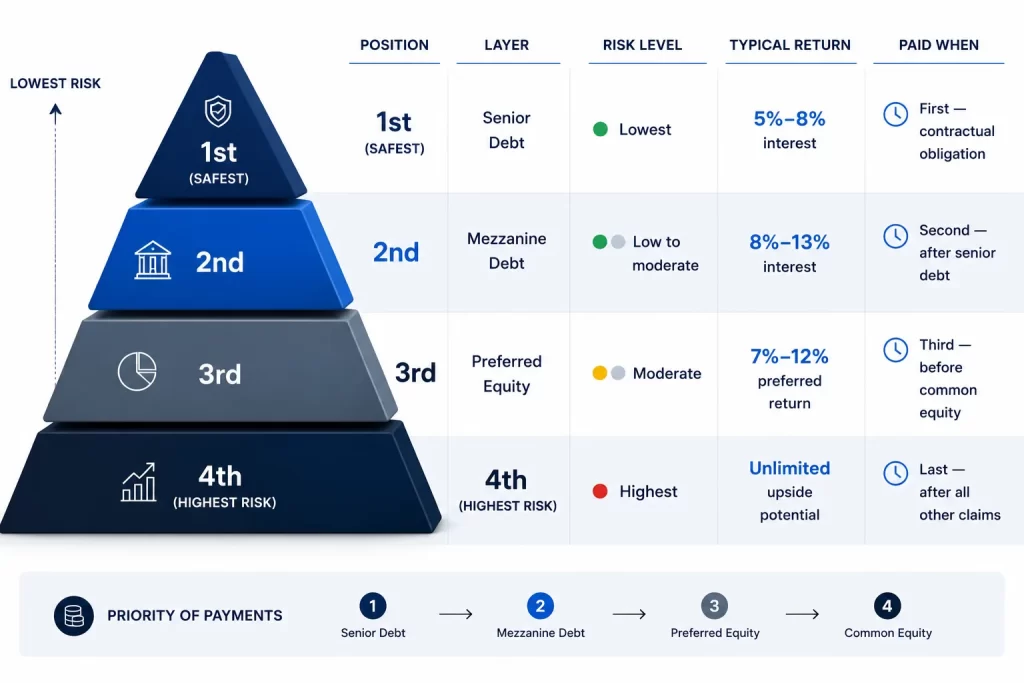
The key principle: lower in the stack = higher risk = higher potential return. Senior lenders take the least risk and earn the most predictable return. Common equity investors take the most risk and — if the deal succeeds — capture the greatest upside.
Layer 1: Senior Debt
Senior debt is the first mortgage on a property — the primary loan from a bank, agency lender (Fannie Mae or Freddie Mac), insurance company, or debt fund. It is the largest single component of most real estate capital stacks, typically representing 55%–75% of the total capitalization.
Senior debt holders have the highest claim on the property’s cash flow and assets. If the deal defaults, the senior lender forecloses first and is repaid before any other party receives anything. In exchange for this security, senior lenders accept the lowest returns — typically in the form of a fixed or floating interest rate.
Key characteristics of senior debt:
- Secured by the physical property (first lien position)
- Repaid through regular interest payments and eventual principal payoff
- Non-recourse in most institutional real estate transactions (lender cannot pursue the borrower’s personal assets beyond the property)
- Lowest cost of capital in the stack — and therefore used to maximize leverage efficiency
In a well-structured multifamily deal, the senior loan-to-value (LTV) ratio is typically kept at 65%–75% to maintain a healthy debt service coverage ratio (DSCR) and provide a buffer against value declines.
Layer 2: Mezzanine Debt
Mezzanine debt is subordinate financing that sits between senior debt and equity in the capital stack. It is used when the senior loan does not cover the full acquisition cost and the sponsor wants to minimize the equity requirement without giving up ownership stake. Mezzanine lenders are secured not by the property directly, but by a pledge of the ownership interest in the entity that holds the property.
Because mezzanine lenders sit behind the senior lender in the repayment order, they accept significantly more risk — and demand higher returns to compensate, typically in the 8%–13% range.
Not all multifamily deals use mezzanine debt. In simpler capital structures — which are often preferred for value-add deals targeting passive investors — the stack consists only of senior debt and equity layers. Mezzanine debt is more common in large-scale development projects, bridge loan structures, or deals with complex capital needs.
Key characteristics of mezzanine debt:
- Secured by ownership interest (pledge of equity), not the physical property
- Subordinate to senior debt — repaid after senior lender in a default
- Higher interest rate than senior debt to reflect elevated risk
- May include equity participation rights (warrants or conversion features) in some structures
- Typically used by institutional sponsors on larger deals
Layer 3: Preferred Equity
Preferred equity is a hybrid instrument that sits between mezzanine debt and common equity — providing investors with a defined, priority return before common equity partners receive any distributions. Unlike debt, preferred equity does not carry a contractual repayment obligation in the same legal sense as a loan. But preferred equity holders are paid ahead of common equity investors in all distributions and upon the sale of the asset.
This is the layer where many passive investors in real estate syndications participate. When a sponsor offers a preferred return — often 6%, 7%, or 8% annually — they are providing a preferred equity position to limited partner investors before the sponsor and other common equity partners share in the profits.
Key characteristics of preferred equity:
- Priority distribution over common equity in cash flow and sale proceeds
- Defined preferred return (e.g. 6%–8% annually) paid before any profits are shared
- Does not participate in upside beyond the preferred return in some structures — but in syndications, preferred equity investors often also receive a share of profits above the preferred return (the “upside participation”)
- Lower risk than common equity — but higher risk than any debt position
- No hard maturity date in most syndication structures
In a Northwind deal: passive investors (limited partners) receive a preferred return before the general partner earns any promoted interest. This structure ensures investor returns are prioritized and the sponsor only profits meaningfully when investors have been paid well.
Layer 4: Common Equity
Common equity is the most junior layer of the capital stack — the last to be paid in any distribution waterfall, and the first to absorb losses if the deal underperforms. The sponsor (general partner) and any co-investing limited partners who have not received a preferred equity structure typically hold common equity.
Common equity holders bear the greatest risk — but they also capture the greatest upside. If a value-add multifamily deal generates a 2.2x MOIC and an 18% IRR, common equity investors share in all returns above the preferred return threshold, often receiving 20%–30% of profits through the promote structure.
Key characteristics of common equity:
- Last in line for distributions and sale proceeds
- No guaranteed return — outcome depends entirely on deal performance
- Maximum upside participation — profits above all other claims flow here
- Held primarily by the general partner (sponsor), sometimes alongside select limited partners
- The GP’s promoted interest (carried interest) typically represents 20%–30% of profits above a hurdle rate
How the Capital Stack Affects Your Returns as a Passive Investor
The position you occupy in the capital stack directly shapes your risk-return profile. Here is a practical illustration using a $10,000,000 multifamily acquisition:
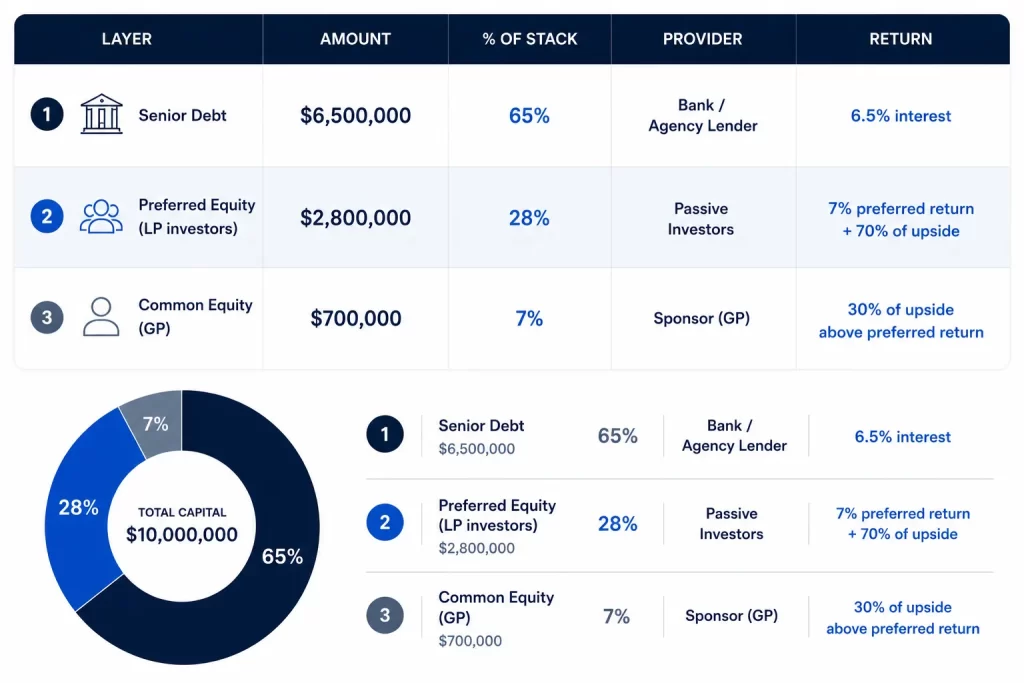
In this structure, passive investors contribute 28% of the total capitalization and receive:
- A 7% preferred return annually before the sponsor earns a dollar of profit
- 70% of all profits above the preferred return when the property is sold
The sponsor contributes 7% as co-investment (a key alignment mechanism), takes on the management responsibility, and earns 30% of profits above the investor threshold.
What happens if the deal underperforms: If NOI falls short and the property sells for less than expected, passive investors (preferred equity) are still paid ahead of the GP. The sponsor’s promote is the last thing paid — which aligns their incentives with yours. A sponsor who structures deals this way is financially motivated to protect investor capital first.
Questions to Ask a Sponsor About Their Capital Stack
Before investing in any deal, these are the capital stack questions every passive investor should ask:
1. What percentage of the capital stack is debt? A loan-to-value ratio above 75%–80% introduces meaningful risk, particularly in a rising interest rate environment. Ask for the LTV, loan type (fixed or floating), and loan term.
2. Is there mezzanine debt or preferred equity senior to my position? If so, those parties get paid before you do. Understand exactly where you rank in the priority of payments.
3. What is the preferred return structure? Is the preferred return cumulative (unpaid amounts accrue) or non-cumulative? Is it accrued and paid at sale, or paid quarterly from operating cash flow? These details matter significantly.
4. What is the promote/waterfall structure? At what IRR hurdle does the sponsor begin earning promoted interest? What is the profit split above the hurdle? The more investor-friendly the waterfall, the better.
5. Is the sponsor co-investing their own capital? A sponsor who invests their own money alongside yours signals genuine alignment. At Northwind, we co-invest in every deal we bring to our investor partners.
Frequently Asked Questions
What is a capital stack in real estate? A capital stack is the full structure of financing used to acquire a real estate asset, organized by priority of repayment. It typically includes senior debt, mezzanine debt, preferred equity, and common equity — listed from lowest to highest risk. The position of each dollar in the stack determines who gets paid first and how returns are distributed.
Where do passive investors typically sit in the capital stack? Most passive investors in real estate syndications occupy the preferred equity layer — which means they receive a defined preferred return before the general partner earns any promoted interest, and they participate in a share of upside profits above that threshold. This structure provides meaningful downside protection relative to the sponsor’s common equity position.
What is a preferred return in a real estate syndication? A preferred return is a defined annual return — typically 6%–8% — that limited partner investors receive before the sponsor shares in any profits. It is a feature of the preferred equity position in the capital stack and is designed to prioritize investor returns over sponsor compensation.
What is the difference between mezzanine debt and preferred equity? Both sit between senior debt and common equity in the capital stack, but they are legally structured differently. Mezzanine debt is a loan secured by a pledge of ownership interest and has a contractual repayment obligation. Preferred equity is an ownership interest with a priority distribution right, not a loan. In practice, both carry higher risk and return than senior debt and lower risk and return than common equity.
What happens to the capital stack if a deal defaults? In a default, the capital stack determines the order of recovery. Senior debt holders foreclose and are repaid first from the sale of the property. If proceeds cover the senior loan, mezzanine lenders are next. Preferred equity holders follow, and common equity — the last layer — receives whatever remains. In severe defaults, common equity investors can lose their entire investment while senior lenders recover in full.
Why does the capital stack matter for due diligence? The capital stack determines your actual risk exposure in a deal. Two deals with identical projected returns can carry very different risks if one uses 75% senior debt with no mezzanine and the other uses 65% senior debt plus 15% mezzanine debt ahead of your position. Always understand the full stack before committing capital.
Invest With Full Transparency on Every Deal
At Northwind Investment Group, we present the complete capital stack in every investor summary — including loan terms, LTV, preferred return structure, promote waterfall, and co-investment by our team. We believe investors deserve to understand exactly where their capital sits before they deploy it.
- Review active opportunities: portal.northwindig.com
- Learn how we structure deals: northwindig.com/investment-strategy/why-multifamily
- Explore our investor glossary: northwindig.com/insights/glossary
- Talk to our team: (888) 842-0476
People Over Property. Transparency Always.