

A triple net lease — commonly written as NNN lease — is one of the most widely used lease structures in commercial real estate, and one of the most misunderstood by investors who encounter it for the first time. The name sounds technical, but the concept is straightforward: in a triple net lease, the tenant pays not only the base rent to the landlord but also the property’s three primary operating costs — taxes, insurance, and maintenance. The result, for the property owner, is a structure that more closely resembles a passive income stream than a traditional landlord relationship. This guide explains what a triple net lease is, how it works, what returns to expect, and the risks every investor should weigh before deploying capital into NNN commercial real estate.
What Is a Triple Net Lease?
A triple net lease (NNN) is a commercial lease agreement in which the tenant is responsible for paying property taxes, building insurance, and maintenance costs — in addition to base rent — for the duration of the lease term.
Unlike a gross lease — where the landlord collects one all-inclusive rent payment and pays all operating expenses from it — a triple net lease shifts the cost burden of operating the property to the tenant. The landlord receives base rent, and the tenant handles the rest. For long-term leases with creditworthy tenants, this creates a highly predictable, low-management income stream for property owners.
The “triple” in triple net refers to the three expense categories the tenant absorbs: real estate taxes (the first net), property insurance (the second net), and maintenance and repairs (the third net). In some NNN leases, the tenant is also responsible for roof and structure — though these provisions vary by agreement and should be reviewed carefully in any specific lease.
NNN Leases vs. Other Commercial Lease Structures
Commercial real estate leases exist on a spectrum from fully gross (landlord pays all expenses) to fully net (tenant pays all expenses). Understanding where NNN sits on that spectrum is the starting point for any commercial real estate investor.
| Lease Type | Who Pays Taxes | Who Pays Insurance | Who Pays Maintenance | Landlord Obligation |
|---|---|---|---|---|
| Gross Lease | Landlord | Landlord | Landlord | All operating costs |
| Net Lease (Single Net / N) | Tenant | Landlord | Landlord | Insurance + maintenance |
| Double Net Lease (NN) | Tenant | Tenant | Landlord | Maintenance only |
| Triple Net Lease (NNN) | Tenant | Tenant | Tenant | Minimal (varies by lease) |
| Absolute NNN (Bondable Lease) | Tenant | Tenant | Tenant + roof/structure | None |
An absolute NNN lease — sometimes called a bondable lease — goes one step further: the tenant is responsible for every cost associated with the property, including roof replacement and structural repairs, regardless of cause. This is the lease type favored by large national restaurant chains (McDonald’s, Starbucks, Chick-fil-A) and pharmacy operators (Walgreens, CVS) in ground lease and fee-simple transactions with institutional investors.
How NNN Leases Generate Income
The income model in a triple net lease is simpler than most commercial real estate structures:
Base rent income. The tenant pays a fixed monthly rent. Because the tenant absorbs operating costs, base rent in a NNN lease is set lower than comparable gross lease rents — but the landlord’s net income is more predictable, because they are not exposed to rising property taxes, insurance premiums, or maintenance costs.
Rent escalation clauses. Most NNN leases include scheduled rent increases — typically 1%–2% per year, or 10% every five years — which protect landlord income against inflation over the life of a long-term lease. These escalators are contractual, not dependent on market conditions.
Lease term. NNN leases are long-term by design. Initial terms of 10 to 25 years are common. National tenant NNN leases often come with corporate-guaranteed obligations, meaning the parent company (not just the franchisee) backs the lease. This credit quality is a central feature of the NNN investment thesis.
Minimal landlord obligations. Because the tenant manages day-to-day maintenance, insurance, and taxes, the landlord’s operational involvement is reduced significantly. Many NNN investors describe the structure as close to “mailbox money” — though this characterization oversimplifies the real risks, discussed below.
Types of NNN Properties
NNN leases are concentrated in specific asset types where long-term single-tenant occupancy is operationally practical.
Retail (single-tenant) is the most common NNN category. Fast food restaurants, convenience stores, dollar stores, pharmacies, and auto parts retailers frequently occupy NNN-leased freestanding buildings. These are the assets most commonly discussed in NNN investment circles — properties occupied by nationally recognized brands on long initial terms with corporate lease guarantees.
Medical and healthcare facilities — urgent care clinics, dialysis centers, dental practices, and medical office buildings — are a growing NNN category. Medical tenants typically sign 10–15 year leases with strong credit, and the demand for healthcare services provides relative recession resistance.
Industrial and logistics properties — distribution centers, manufacturing facilities, and flex industrial buildings — are increasingly structured as NNN or modified NNN leases, particularly for single-tenant occupancy. The surge in e-commerce drove significant demand for long-term industrial NNN leases from creditworthy logistics operators.
Net-leased office properties are the highest-risk NNN category. Long-term office leases were historically considered safe, but structural shifts in office demand following 2020 have made single-tenant office NNN a more complex underwriting exercise — particularly for suburban markets.
Cap Rates and NNN Property Valuation
NNN properties are valued using the same cap rate formula that applies across commercial real estate — but NNN cap rates reflect the unique risk-return profile of the lease structure.
Property Value = NOI ÷ Cap Rate
For a primer on NOI, see our guide to NOI in Real Estate. For context on cap rate interpretation, see What Is a Good Cap Rate?
NNN cap rates vary significantly by tenant credit quality, lease term remaining, and property type:
| Tenant / Property Type | Typical NNN Cap Rate Range |
|---|---|
| Investment-grade credit (McDonald’s, Walgreens, 7-Eleven) | 4.0%–5.5% |
| Strong non-rated credit (regional chains, strong local franchisees) | 5.5%–7.0% |
| Healthcare / medical office | 5.0%–6.5% |
| Dollar stores (Dollar General, Family Dollar) | 5.5%–6.5% |
| Industrial NNN (single-tenant) | 5.0%–6.5% |
| Restaurant (franchisee, not corporate guarantee) | 6.5%–8.5%+ |
Why are NNN cap rates often lower than multifamily cap rates? Because investors pay a premium for the lease structure — the long term, the corporate guarantee, the minimal operating burden. A McDonald’s NNN with 20 years remaining and a corporate guarantee is a very different risk profile than a 150-unit apartment complex requiring active management across hundreds of tenant relationships. The lower cap rate reflects that difference in operating complexity and credit quality.
However, it also means less built-in return. At a 4.5% cap rate with 1.5% annual rent escalators, NNN investors are accepting a low initial yield in exchange for predictability and ease — a trade-off that should be evaluated carefully against other real estate investment vehicles.
Advantages of NNN Leases for Investors
Predictable, contractual income. Base rent is fixed for the lease term. Unlike multifamily real estate, where income depends on occupancy rates, lease renewals, and market rents, NNN income is contracted years in advance. For investors who value cash flow predictability over return maximization, this is the primary appeal.
Reduced management burden. Because tenants handle taxes, insurance, and maintenance, NNN landlords are not fielding maintenance calls, managing vendors, or responding to operational issues. This is among the most passive of all direct real estate ownership structures.
Long lease terms with national tenants. A 15-year corporate-guaranteed NNN lease from an investment-grade tenant is a materially different risk profile than a month-to-month apartment lease. National tenant credit provides a layer of income security that is difficult to replicate in other commercial or residential real estate structures.
1031 exchange compatibility. NNN properties are frequently used in 1031 exchange transactions — investors who have sold appreciated real estate use NNN properties as replacement assets to defer capital gains while entering a low-management investment. The long lease terms and simplicity of operations make them attractive 1031 targets. See our guide to Investor Education for more on how key metrics interact in a real estate portfolio context.
Delaware Statutory Trust (DST) access. For accredited investors who want passive NNN exposure without direct ownership, DSTs allow fractional co-investment in institutional-quality NNN assets — fully passive, 1031-compatible, and available at lower minimums than direct purchase. To understand what “accredited investor” status requires, see our guide to Accredited Investor vs. Qualified Purchaser.
The Risks of NNN Investing
The passive income narrative of NNN leases is real — but so are the risks. Investors who treat NNN as risk-free income are often surprised when the model breaks down.
Tenant credit risk. A NNN lease is only as strong as the tenant’s ability to pay. When a national tenant closes locations — as many retailers, pharmacies, and restaurant chains have done in recent cycles — NNN landlords discover that their “passive income” comes with vacancy risk. A dark NNN property (tenant gone, building empty) is often difficult to re-lease, particularly if the building was constructed specifically for the departing tenant’s use.
Single-tenant concentration. Most NNN investments involve one tenant in one property. If that tenant fails, income drops to zero immediately. Unlike a 150-unit multifamily property where one vacancy is 0.7% of income, a single-tenant NNN property has no diversification buffer.
Interest rate sensitivity. NNN properties trade on cap rates that are closely tied to the risk-free rate (U.S. Treasury yields). When interest rates rise significantly — as they did in 2022–2024 — NNN cap rates expand and property values decline, even when the lease itself remains intact and the tenant is paying rent. Investors who acquired NNN properties at 4.0%–4.5% cap rates in 2020–2021 saw paper losses as cap rates expanded to 5.5%–6.5% in 2023–2024.
Limited upside from appreciation. Unlike value-add real estate, where an operator can actively grow NOI and force appreciation, NNN returns are largely capped at the contracted rent escalation rate. A 1.5% annual rent bump on a 20-year lease means the tenant — not the market — is setting the income ceiling. In high-inflation environments, locked-in escalators can significantly underperform actual inflation.
Re-leasing complexity. When a NNN lease expires, the landlord faces a re-leasing process that can require significant capital — especially if the building was purpose-built for the outgoing tenant. A former Bed Bath & Beyond or Pier 1 location is a large-format retail building with limited alternative uses. Re-tenanting costs can be substantial, eroding the low-management narrative of the NNN model.
Roof and structure carve-outs. Not all NNN leases are equal. Many NNN leases that appear absolute are actually modified — the landlord retains responsibility for roof, structure, or HVAC beyond a certain age. Reading the actual lease, not the offering memorandum summary, is essential due diligence.
NNN Investing Vehicles for Accredited Investors
Direct NNN property ownership is accessible to investors with sufficient capital — single-tenant NNN retail trades from approximately $1M to $20M+, depending on size, market, and tenant. But accredited investors can access NNN exposure through several additional vehicles:
Direct fee-simple ownership. You own the land and building outright. All income flows to you; all appreciation (or depreciation) is yours. Financing is available, though lenders scrutinize remaining lease term — a 5-year remaining term is harder to finance than 20 years.
Delaware Statutory Trusts (DSTs). DSTs allow multiple accredited investors to hold fractional interests in institutional NNN assets as a 1031-compatible passive investment. Minimums are typically $25,000–$100,000. DSTs are fully passive — you cannot control management — and illiquid for the asset’s duration.
NNN REITs. Publicly traded REITs specializing in net-lease properties (Realty Income, NNN REIT, STORE Capital) provide NNN exposure with daily liquidity. The trade-off: public NNN REITs trade like stocks in the short term and are subject to the same market correlation that reduces the diversification benefit of private real estate.
Tenant-in-Common (TIC) structures. Fractional ownership structures similar to DSTs, also 1031-compatible but with co-ownership and decision-making rights. More complex to structure and exit than DSTs.
For context on how these vehicles fit within the broader capital stack of a real estate portfolio, see our guide to the full range of real estate structures available to accredited investors.
NNN vs. Multifamily: Key Differences for Investors
For investors choosing between NNN commercial real estate and multifamily real estate, the comparison comes down to where you want to sit on the income-vs-growth spectrum.
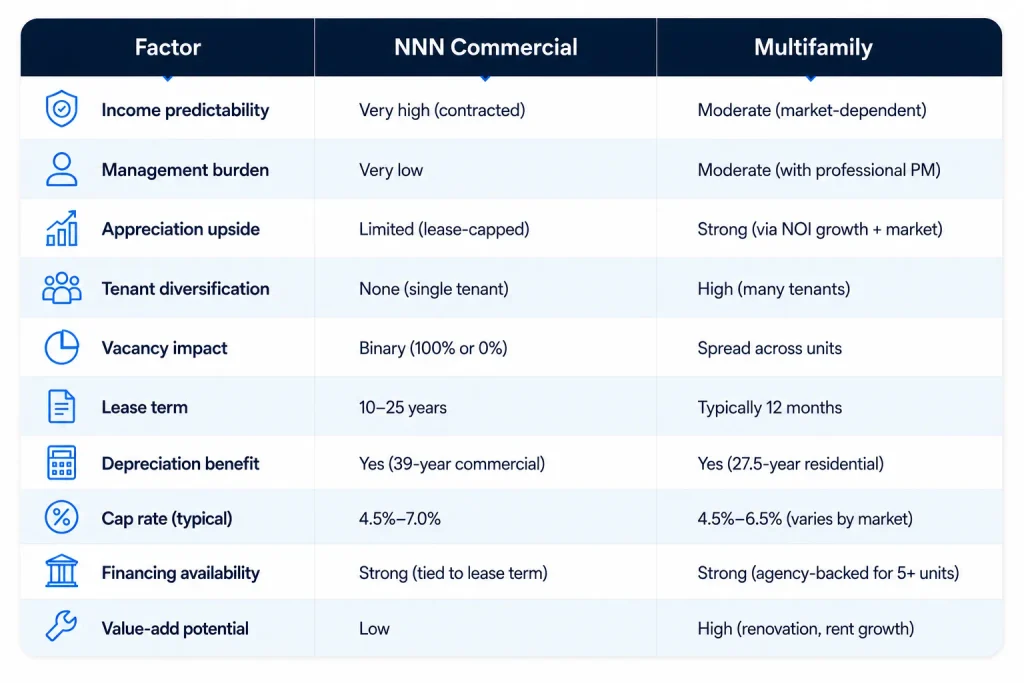
NNN is often positioned as the “simpler” real estate investment — and for investors who want predictable income with minimal management involvement, that characterization holds. But investors seeking active appreciation, forced value creation, and higher long-term equity returns tend to find multifamily investing offers a more powerful engine for building wealth over time.
For more on how passive real estate investment structures compare across asset types, see our broader guide to passive real estate vehicles.
Frequently Asked Questions
What is a triple net lease? A triple net lease (NNN) is a commercial lease in which the tenant pays base rent plus the property’s three primary operating expenses: real estate taxes, building insurance, and maintenance and repairs. The landlord receives net rent income with minimal operating obligations. NNN leases are common in single-tenant retail, healthcare, industrial, and net-leased commercial real estate.
What are the three nets in a triple net lease? The three nets are: (1) real estate taxes — the tenant pays the property tax bill; (2) property insurance — the tenant maintains and pays for building insurance; and (3) maintenance and repairs — the tenant is responsible for upkeep of the property during the lease term. In an absolute or bondable NNN lease, the tenant also covers roof, structure, and any other capital expenditures for the duration of the lease.
Is a triple net lease a good investment? NNN leases offer predictable income, low management burden, and long lease terms with creditworthy tenants — which makes them appealing for certain investor profiles. However, they also carry tenant concentration risk (one tenant equals 100% of income), limited upside from appreciation, and meaningful interest rate sensitivity. NNN works well for investors prioritizing current income and simplicity; investors seeking active appreciation and higher long-term returns often favor multifamily or other value-add commercial real estate.
What cap rates do NNN properties trade at? NNN cap rates vary significantly by tenant credit quality, asset type, and remaining lease term. Investment-grade single-tenant retail (McDonald’s, CVS, 7-Eleven) typically trades at 4.0%–5.5% cap rates. Non-rated or franchisee-operated NNN properties range from 5.5%–8.5%, depending on credit and location. NNN cap rates are closely tied to long-term interest rates and tend to expand when rates rise.
Can NNN leases lose value? Yes. NNN property values are driven by the cap rate formula (Value = NOI ÷ Cap Rate), and when market cap rates expand — as they did significantly in 2022–2024 — property values decline even if the tenant continues paying rent. Investors who acquired NNN properties at 4.0% cap rates in 2020–2021 saw values decline materially as cap rates moved to 5.5%–6.5% three years later. This interest rate sensitivity is a key risk that is often understated in NNN investment marketing.
Who typically uses NNN leases? NNN leases are most commonly used by national and regional tenants with predictable footprints — fast food chains, pharmacies, convenience stores, dollar stores, urgent care clinics, and auto parts retailers. These tenants benefit from controlling their own maintenance and operations within a long-term location commitment. Landlords benefit from predictable income and reduced operating obligations.
Understanding NNN Leases Within a Broader Real Estate Strategy
Triple net leases represent one point on the commercial real estate spectrum — one with appeal for investors who prioritize income stability and operational simplicity. But that simplicity comes at a cost: limited upside, single-tenant concentration, and meaningful sensitivity to interest rate movements.
At Northwind Investment Group, our focus is on Class A and Class B multifamily real estate — an asset class where we can actively create value through operational improvements, unit renovations, and income growth that drives forced appreciation independent of market cap rate movements. Understanding NNN leases, and how they compare to multifamily equity investing, helps every accredited investor build a portfolio that is intentionally structured rather than opportunistically assembled.
If you are exploring where multifamily fits in your real estate investment portfolio — and how it compares on returns, risk, and cash flow — we would welcome the conversation.