
Qualified investor is a broad term that encompasses several distinct legal standards — and understanding exactly which category you fall into determines which private investment opportunities you can legally access. In private real estate, the two most commonly referenced classifications are accredited investor and qualified purchaser. Both are defined by the SEC, but they operate under different laws, set very different financial thresholds, and unlock different tiers of investment access.
This guide explains what each designation means, how the thresholds compare, why the distinction matters when investing in private real estate, and how sponsors verify investor status before accepting capital.
What Is an Accredited Investor?
An accredited investor is an individual or entity that meets specific income, net worth, or professional licensing criteria established by the SEC under Regulation D, Rule 501 — and is therefore deemed financially sophisticated enough to participate in unregistered securities offerings.
The accredited investor standard was created by the SEC as a way to allow private companies and investment sponsors to raise capital without the full disclosure burden of a public securities registration — on the assumption that investors who meet the financial threshold have sufficient resources and sophistication to evaluate the risk independently.
An individual qualifies as an accredited investor by meeting any one of the following criteria:
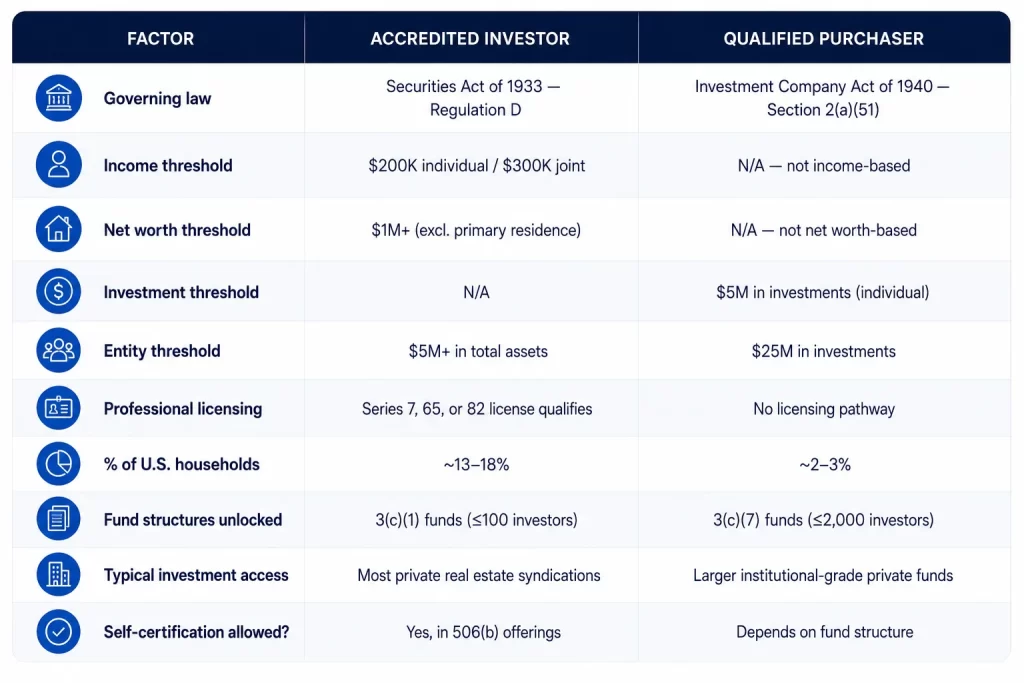
Income test: An individual with income exceeding $200,000 in each of the two most recent years, and a reasonable expectation of reaching the same income in the current year. The threshold rises to $300,000 for joint income with a spouse or spousal equivalent.
Net worth test: An individual (or joint with spouse) with a net worth exceeding $1,000,000, excluding the value of the primary residence.
Professional licensing test: An individual who holds a Series 7, Series 65, or Series 82 securities license in good standing — added by the SEC in 2020 to recognize financial sophistication beyond wealth alone.
Entities can also qualify as accredited investors, including:
- Banks, broker-dealers, insurance companies, and registered investment companies
- Entities with total assets exceeding $5,000,000 (not formed for the purpose of making the specific investment)
- Trusts with total assets exceeding $5,000,000, directed by a “sophisticated person”
- “Knowledgeable employees” of private funds they are investing in
According to SEC estimates, approximately 13–18% of U.S. households currently qualify as accredited investors — making this the most common investor classification in private markets.
What Is a Qualified Purchaser?
A qualified purchaser is an individual or entity that meets a significantly higher financial threshold than an accredited investor — as defined under Section 2(a)(51) of the Investment Company Act of 1940 — and is therefore eligible to invest in a distinct category of private funds not open to ordinary accredited investors.
The qualified purchaser standard exists within the Investment Company Act, which governs investment companies (funds) rather than individual securities offerings. Most private investment funds must register with the SEC as investment companies — unless they qualify for an exemption. The two most common exemptions are:
- Section 3(c)(1): Available to funds with no more than 100 investors. Generally open to accredited investors. Most smaller real estate syndications use this structure.
- Section 3(c)(7): Available to funds with up to 2,000 investors — but all investors must be qualified purchasers. This structure is used by larger, institutional-grade private funds.
An individual qualifies as a qualified purchaser by meeting this threshold:
An individual (or family-owned company) that owns at least $5,000,000 in investments — not net worth, but specifically “investments” as defined by the Investment Company Act (securities, real estate held for investment, commodity interests, and similar assets, excluding the primary residence and any property used in a business).
Entities qualify as qualified purchasers if they have at least $25,000,000 in investments, or if they are trusts or companies in which each beneficial owner is a qualified purchaser.
Qualified purchasers represent a much smaller share of the investing population than accredited investors — roughly 2–3% of U.S. households, concentrated among high-net-worth individuals, family offices, and institutional investors.
A Third Category: Qualified Client
There is a third, middle-tier designation worth understanding — the qualified client.
A qualified client is an individual or entity with at least $2,200,000 in assets under management with a registered investment adviser, or a net worth exceeding $2,200,000 at the time of investment.
The qualified client threshold is relevant primarily because investment advisers registered with the SEC may only charge performance-based fees (carried interest, profit sharing) to qualified clients or qualified purchasers — not to ordinary accredited investors. This makes it relevant when evaluating how a fund manager structures its compensation, though it does not change which securities an investor may access.
Accredited Investor vs. Qualified Purchaser: Side-by-Side Comparison
Why These Distinctions Matter in Real Estate Investing
In practical terms, the accredited investor and qualified purchaser designations determine the legal universe of private investments you can access.
Accredited Investor Access
The vast majority of private real estate syndications — including value-add multifamily deals, development projects, and private equity real estate funds aimed at individual investors — are structured as Rule 506(b) or Rule 506(c) Regulation D offerings. Both require all investors to be accredited. Accredited investor status is the baseline requirement for almost all private real estate investment at Northwind and across the syndication industry.
Under Rule 506(b), a sponsor may accept up to 35 non-accredited but “sophisticated” investors — but in practice, most professional sponsors require all-accredited pools to simplify compliance and avoid the additional disclosure obligations that come with non-accredited investors.
Under Rule 506(c), general solicitation and advertising of the offering is permitted — but the sponsor must take “reasonable steps” to verify that every investor is, in fact, accredited (not just rely on self-certification).
Qualified Purchaser Access
Qualified purchaser status opens access to Section 3(c)(7) vehicles — typically larger, institutional-grade private funds that can accept a broader number of investors (up to 2,000) and, in some cases, operate under fewer restrictions than smaller 3(c)(1) vehicles. These funds are most common among institutional asset managers, large private equity firms, and family office investment vehicles.
For individual real estate investors, qualified purchaser status matters most when investing in larger private funds that specifically require this designation — a growing category as more family offices and ultra-high-net-worth investors enter the space.
For most passive real estate investors working with sponsors like Northwind, accredited investor status is all that is required. Qualified purchaser status becomes relevant primarily when you scale into institutional-grade fund structures or work with sponsors offering Section 3(c)(7) vehicles.
How Sponsors Verify Investor Status
How an investor’s status is verified depends on the type of offering.
In Rule 506(b) offerings: Investors self-certify. The sponsor provides a questionnaire or subscription agreement in which the investor confirms they meet the applicable standard. The sponsor must have no reason to believe the investor’s self-certification is false, but is not required to independently verify it.
In Rule 506(c) offerings: The sponsor must take “reasonable steps” to verify accredited investor status. Accepted verification methods include:
- A written confirmation letter from a licensed CPA, attorney, broker-dealer, or registered investment adviser, stating that the investor meets the accredited investor standard
- Review of tax returns (to verify income) and bank or brokerage account statements (to verify net worth)
- A confirmation letter from the investor’s financial institution
At Northwind Investment Group, investors access our deals through our investor portal at portal.northwindig.com, where the onboarding process includes investor accreditation acknowledgment and — depending on the offering structure — may include third-party verification documentation.
What If You Are Not Yet an Accredited Investor?
If you do not currently meet accredited investor thresholds, there are still legitimate ways to access real estate investing:
Public REITs (Real Estate Investment Trusts): Traded on public exchanges, available to any investor, no minimums beyond the share price. Lower friction, but also lower return potential and direct exposure to public market volatility.
Non-traded REITs and interval funds: Registered investment products that can accept non-accredited investors, subject to SEC registration and disclosure requirements. More accessible, but with less flexibility and often higher fees than private syndications.
JOBS Act crowdfunding platforms (Regulation CF): Allows non-accredited investors to participate in small private offerings, subject to annual investment limits based on income and net worth.
None of these alternatives provide the same combination of return potential, tax efficiency, and alignment of incentives that characterizes institutional-quality private real estate syndications — but they offer a legitimate on-ramp while you build toward accredited investor status.
Frequently Asked Questions
What is a qualified investor in real estate? The term “qualified investor” is used informally to refer to investors who meet one of the SEC’s investor classification thresholds — most commonly “accredited investor” or “qualified purchaser.” In private real estate, the accredited investor standard (either $200K+ income or $1M+ net worth excluding primary residence) is the most common requirement for participating in private syndications and Regulation D offerings.
What is the difference between an accredited investor and a qualified purchaser? An accredited investor meets income or net worth thresholds under Regulation D of the Securities Act. A qualified purchaser meets a higher investment threshold ($5M+ in investments for individuals) under the Investment Company Act of 1940. Qualified purchasers can access larger Section 3(c)(7) funds with up to 2,000 investors, while accredited investors typically access Section 3(c)(1) funds limited to 100 investors. Most private real estate syndications require only accredited investor status.
How do I know if I qualify as an accredited investor? You qualify as an accredited investor if you meet any one of these criteria: (1) individual income over $200,000 for the past two years, (2) joint income with a spouse over $300,000, (3) net worth over $1,000,000 excluding your primary residence, or (4) you hold a current Series 7, Series 65, or Series 82 securities license. Consult a CPA or financial adviser to confirm your status before investing.
Do I need to be a qualified purchaser to invest with Northwind? No. Northwind’s private real estate offerings are structured to be accessible to accredited investors. You do not need qualified purchaser status ($5M in investments) to participate in our deals. You can confirm your accreditation status and begin the investor onboarding process at portal.northwindig.com.
Can my net worth from my home count toward the accredited investor threshold? No. The SEC specifically excludes the value of your primary residence from the net worth calculation for accredited investor status. If your home is worth $800,000 and you own it free and clear, that value does not count toward the $1,000,000 net worth threshold.
What does Reg D mean in private real estate investing? Regulation D (Reg D) is a set of SEC rules that allows companies and investment sponsors to raise capital through private placements without registering the offering with the SEC. The most commonly used exemptions — Rule 506(b) and Rule 506(c) — require investors to be accredited. Most private real estate syndications are structured as Reg D offerings, which is why the accredited investor standard is so widely referenced in private real estate.
Verify Your Status and Start Exploring Opportunities
Understanding your investor classification is the first practical step to accessing private real estate deals. If you are an accredited investor, you are eligible to explore Northwind’s current multifamily investment opportunities — without needing qualified purchaser status or any other additional designation.