

Real estate debt financing — lending capital to property owners, developers, and operators rather than owning equity in the deal — has become one of the most discussed corners of private markets for accredited investors. Real estate debt funds pool capital from investors to deploy as loans secured by real property, offering a different risk-return profile than equity investing: lower potential upside, but a senior position in the capital stack, contractual income, and meaningful downside protection.
This guide explains what real estate debt funds are, the types that exist, what returns to expect, how they compare to equity investing, and how to evaluate whether a debt fund deserves a place in your real estate portfolio.
What Is a Real Estate Debt Fund?
A real estate debt fund is a pooled investment vehicle that deploys capital in the form of loans secured by real property, rather than as equity ownership. Investors in a debt fund are, in effect, acting as the lender — providing financing to property owners or developers in exchange for contractual interest payments and the security of a first or second lien on the underlying asset.
Real estate debt financing has always existed in the form of bank mortgages and agency loans. What changed over the past two decades — and accelerated after the 2008 financial crisis and again during the 2022–2024 rate cycle — is the rise of private credit and private debt funds, which now fill lending roles that traditional banks have pulled back from: bridge loans for value-add acquisitions, construction financing for development projects, and mezzanine loans for deals that exceed the capacity of a single senior lender.
Today, private real estate debt funds represent a multi-trillion-dollar segment of the broader private credit market, with participation from institutional investors, family offices, and increasingly, accredited individual investors through private funds and syndications.
Types of Real Estate Debt Funds
Not all real estate debt is the same. Funds vary significantly by the type of loans they originate, the position they occupy in the capital stack, and the risk-return profile they target.
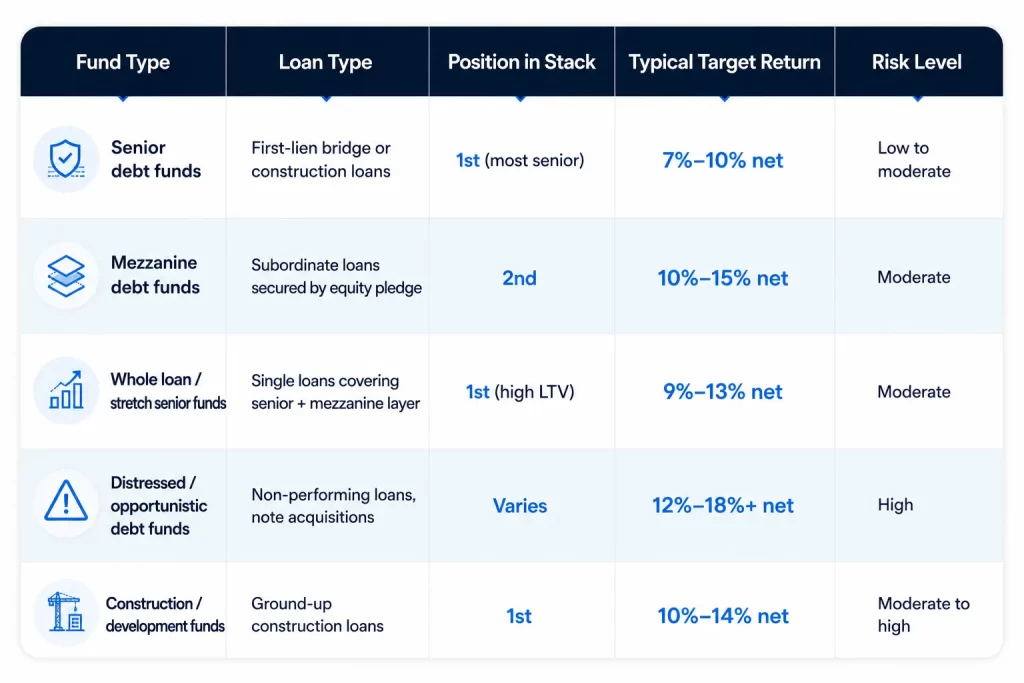
Senior bridge debt funds are the most common structure available to accredited investors in private markets. These funds originate first-lien bridge loans — typically 12 to 36 months — on properties that are being acquired for value-add repositioning. The property serves as collateral, and the loan is sized conservatively (typically 60%–75% loan-to-value) to protect the fund in a downside scenario.
For a deeper look at one specific type of subordinate real estate debt, see our guide to mezzanine debt in real estate.
How Real Estate Debt Financing Generates Returns for Investors
Unlike equity investing — where returns come from cash flow distributions and eventual sale proceeds — real estate debt funds generate income primarily through interest.
Interest income: The borrower pays interest on the outstanding loan balance, typically monthly or quarterly. This interest flows through the fund to investors as income distributions. Senior bridge loans for multifamily value-add deals currently price at SOFR plus a spread, which in 2024–2025 translated to all-in rates in the 8%–11% range depending on borrower quality and LTV.
Origination fees: Debt funds often charge borrowers 1%–2% origination points at close, which are typically passed through to the fund and represent additional yield on top of the stated interest rate.
Exit fees: Some debt funds charge a fee at loan payoff, providing additional return at the end of the loan term.
No appreciation component: Unlike equity, debt funds do not participate in property value appreciation. If a value-add deal is acquired at $5M and sold 4 years later for $8M, the debt fund lender earns only its contractual interest — not a share of the $3M gain. This is the fundamental trade-off: lower ceiling in exchange for a more predictable, contractually secured income stream.
Real Estate Debt Funds vs. Equity Investing: Key Differences
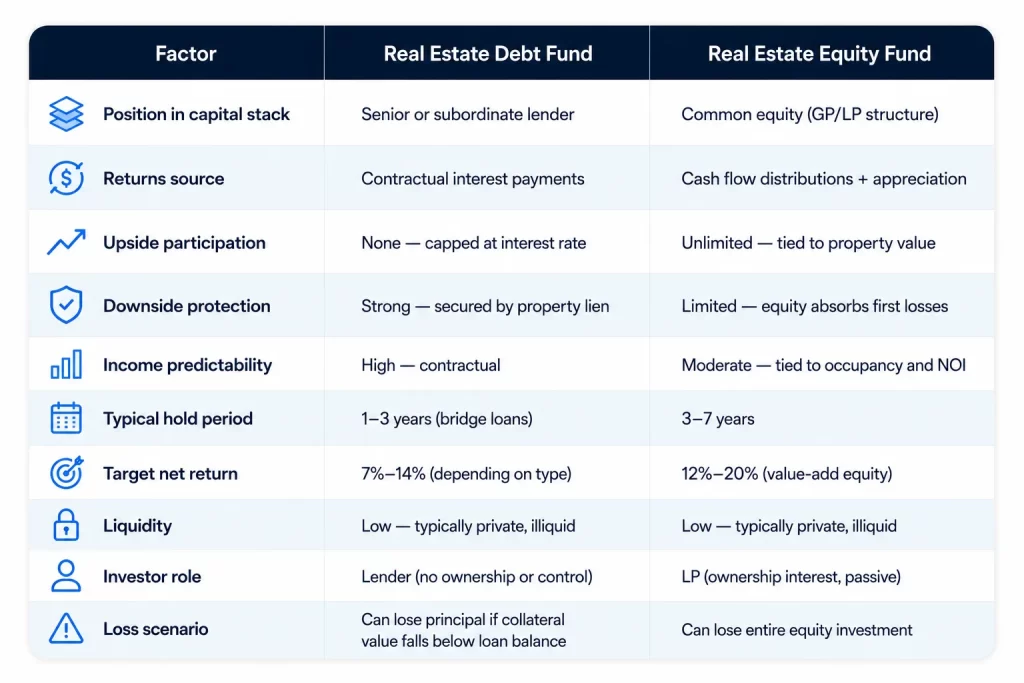
For a detailed comparison of the metrics used to evaluate equity deals, see our guides to IRR in Real Estate and cap rates.
Why Real Estate Debt Funds Belong in a Diversified Portfolio
For investors already holding equity positions in private real estate, debt funds can serve a complementary role in a portfolio for several structural reasons.
Lower correlation to equity market volatility. Real estate debt funds generate income from contractual loan payments — which are not directly tied to public equity market movements. During periods of equity market stress, a debt fund’s income stream can provide stability.
Senior position provides meaningful downside cushion. A well-underwritten senior bridge loan at 65% LTV requires the underlying property to lose more than 35% of its value before the lender’s principal is at risk. For an equity investor in the same deal, any decline in value below the purchase price represents a direct loss. The lender’s senior lien provides a meaningful buffer.
Shorter duration means faster capital recycling. Bridge loans typically mature in 12 to 36 months. This shorter duration means investor capital is recycled more frequently — returning principal sooner and allowing redeployment into new opportunities as market conditions change. Equity deals typically lock up capital for 3 to 7 years.
Elevated interest rate environment has improved debt fund yields. The Federal Reserve’s rate cycle of 2022–2024 compressed equity returns across real estate while simultaneously widening loan spreads and increasing all-in yields on private debt. Investors who entered debt funds during this period captured returns that had historically required taking equity risk.
Diversification of deal exposure. A debt fund with a portfolio of 20–40 loans across multiple markets, asset classes, and borrowers provides diversification that a single-asset equity syndication cannot. Even if one loan underperforms, the impact on the overall portfolio is limited.
The Risks of Real Estate Debt Investing
Debt investing in real estate is not without risk. Investors should understand these before committing capital:
Credit risk. If a borrower defaults, the fund must exercise its enforcement rights — pursuing a foreclosure or negotiating a loan modification. Even with strong collateral, this process takes time and incurs legal costs, reducing net returns.
Collateral value risk. If the underlying property value drops significantly, the loan-to-value ratio deteriorates. A loan originated at 65% LTV on a $10M property is secured by $6.5M in value. If the property falls to $7.5M, the LTV rises to 87% — and the lender’s margin of safety shrinks materially.
Extension and liquidity risk. Bridge loans are short-term by design — but borrowers don’t always exit on schedule. If a value-add project takes longer than expected, or if the property can’t be refinanced into permanent financing, loans get extended. This ties up investor capital beyond the projected timeline.
Interest rate risk. Most bridge loans are floating rate — benchmarked to SOFR or the prime rate. When rates decline, the interest income on floating-rate debt funds falls. Fixed-rate funds face the reverse problem: if rates rise after origination, the loan yield looks relatively unattractive.
Manager quality. The performance of a real estate debt fund depends heavily on the underwriting discipline of the manager — the loan-to-value standards they enforce, the markets they lend in, the due diligence on borrowers, and how they manage workouts on problem loans. Not all debt fund managers are equally skilled at origination and workout.
What to Evaluate Before Investing in a Real Estate Debt Fund
When reviewing any real estate debt fund opportunity, these are the key diligence questions:
What is the average LTV of the loan portfolio? Lower LTV loans carry more collateral cushion. A portfolio averaging 60%–65% LTV on first-lien loans is conservative; 75%–80% introduces meaningfully more risk.
What asset types are in the portfolio? Multifamily bridge loans have historically defaulted at lower rates than retail, office, or hospitality. The composition of the portfolio matters.
What is the loan diversification? A fund with 5 large loans is far more concentrated — and riskier — than one with 40 smaller loans spread across multiple markets.
What is the fund’s track record on loan performance and loss rates? Has the manager experienced loan defaults? How were workouts handled? What were actual investor returns versus projected returns?
How is the preferred return structured? Understanding whether the return is a hard preferred (paid from a cash waterfall before any promote) or a soft return (subject to fund-level adjustments) matters significantly for actual investor outcomes. For more on how preferred returns work, see our article on preferred equity.
What is the minimum investment and liquidity profile? Most private debt funds require $50,000–$250,000 minimums and have limited or no liquidity options during the fund term. Investors should understand the lock-up structure before committing capital.
How Northwind Approaches Real Estate Debt
At Northwind Investment Group, we are an equity sponsor — not a debt fund. Our strategy centers on acquiring and operating Class A and Class B multifamily properties as the GP, creating value through renovation, operations, and market selection, and delivering equity returns to our LP investors.
That said, understanding real estate debt financing is essential context for every investor who evaluates our deals. When we acquire a property, senior bridge debt or agency debt is the first layer of our capital stack — and knowing how that debt is structured, what it costs, and what it protects against is part of understanding the full risk-return picture of any syndication.
Real estate debt funds and equity funds are not competitors — they are complementary positions that serve different goals in a portfolio. Debt provides predictable income and senior-secured downside protection. Equity provides the upside participation and long-term wealth creation that comes from forced appreciation and market growth. Many sophisticated investors hold both.
If your goal is to build wealth over time through disciplined multifamily equity investing, we’d welcome the conversation.
Frequently Asked Questions
What is real estate debt financing? Real estate debt financing refers to capital provided to property owners or developers in the form of loans — as opposed to equity investment. The lender earns a contractual interest rate and holds a lien on the property as security. Real estate debt can come from banks, agency lenders (Fannie Mae, Freddie Mac), insurance companies, or private credit funds, each serving different deal types and risk profiles.
How does a real estate debt fund work? A real estate debt fund pools capital from investors and deploys it as loans to real estate borrowers — typically bridge loans for acquisitions or value-add projects, construction loans for development, or mezzanine loans for deals that require more financing than a senior lender will provide. Investors earn returns through interest payments passed through the fund, plus any origination or exit fees. Unlike equity funds, debt fund investors do not participate in property appreciation.
What returns can I expect from a real estate debt fund? Returns vary significantly by loan type and risk level. Senior bridge debt funds targeting first-lien loans at conservative LTVs typically deliver net returns of 7%–10%. Mezzanine debt funds and higher-leverage structures typically target 10%–15% net. These returns are lower than value-add equity targets but come with a senior-secured position and more contractual income predictability.
Is real estate debt investing safer than equity investing? Debt investing generally carries less downside risk than equity investing in the same property, because lenders occupy a senior position in the capital stack and are secured by a property lien. However, “safer” is relative — debt fund returns can be impaired by borrower defaults, collateral value declines, or manager underwriting errors. All private real estate investment involves risk.
What is the difference between a real estate debt fund and a REIT? REITs (Real Estate Investment Trusts) are publicly traded or public non-traded vehicles that typically own real estate equity — the properties themselves. Some REITs focus on mortgage loans (called Mortgage REITs or mREITs), which are similar in spirit to debt funds but are registered securities subject to SEC reporting, traded on exchanges (for public mREITs), and carry different tax and liquidity characteristics. Private real estate debt funds are typically illiquid, available only to accredited investors, and structured as private placements.
Can I invest in a real estate debt fund alongside equity deals? Yes — and many sophisticated investors do. Real estate debt and equity serve different purposes in a portfolio. Debt funds provide contractual income and senior-secured positions with shorter duration. Equity deals provide appreciation potential, tax efficiency through depreciation, and longer-term wealth building. Holding both creates a portfolio that balances current income with growth.
Build a Diversified Real Estate Portfolio
Understanding real estate debt financing helps you see the full spectrum of private real estate investing — from the secured, income-oriented approach of debt funds to the appreciation-driven, value-add approach of equity syndications. Both have a role. The question is what role each plays in your specific strategy.
If you are ready to explore the equity side of that equation — with a professionally managed, Class B multifamily deal that is conservatively financed and transparently structured — Northwind is a starting point worth exploring.