

Real estate classes — Class A, Class B, and Class C — are the classification system investors, brokers, and lenders use to describe a property’s age, condition, location, and tenant profile. Every commercial real estate property, particularly multifamily apartments, falls somewhere on this spectrum. Understanding what separates each class is one of the most foundational skills for any real estate investor, because the class of a property drives its risk profile, return potential, financing terms, and management requirements.
This guide breaks down what defines each class, how properties get classified, and why many experienced investors — including Northwind — believe Class B and C properties deliver the strongest risk-adjusted returns in the multifamily sector.
What Are Real Estate Classes?
Real estate classes are a tiered classification system — typically Class A, B, C, and occasionally D — used to rank commercial properties by age, condition, location quality, and tenant income level. The classification is not an official or regulated standard; rather, it is an industry convention used by appraisers, brokers, lenders, and investors to communicate a property’s general quality and risk profile quickly.
Classification applies to most commercial real estate types — multifamily, office, retail, and industrial — but it is most commonly used and most consequential in multifamily investing, where it directly correlates with tenant demographics, rent levels, and investment strategy.
Class A Properties
Class A properties are the newest, highest-quality assets in a market — typically built within the last 10–15 years, located in premium locations, and offering high-end finishes and amenities. Class A multifamily properties target tenants with higher household incomes and command the highest rents in their market.
Key characteristics of Class A properties:
- Built within the last 10–15 years (or recently renovated to that standard)
- Premium locations — urban cores, walkable submarkets, top school districts
- High-end finishes: stainless steel appliances, quartz countertops, in-unit washer/dryers
- Resort-style amenities: pools, fitness centers, co-working spaces, concierge services
- Lowest cap rates in the market (typically 3.5%–5.0%)
- Tenants: higher-income professionals, often renters by choice rather than necessity
Class B Properties
Class B properties are well-maintained, middle-tier assets — typically 15 to 30 years old, located in stable neighborhoods, and occupied by working-class and middle-income tenants. Class B properties are not luxury, but they are functional, attractive, and often present strong value-add opportunities through renovation and operational improvement.
Key characteristics of Class B properties:
- Built 15–30 years ago, in good structural condition
- Located in stable or improving suburban and secondary urban markets
- Moderate finishes — functional but not luxury
- Some amenities, though typically fewer than Class A
- Cap rates typically in the 4.5%–6.5% range
- Tenants: teachers, healthcare workers, tradespeople, and other working professionals
Class C Properties
Class C properties are older assets — typically 30 or more years old — located in lower-income or transitional neighborhoods, often requiring significant capital investment and occupied by tenants who rent out of necessity rather than preference. Class C properties offer the highest potential yields but require the most intensive management and capital planning.
Key characteristics of Class C properties:
- Built 30+ years ago, often with significant deferred maintenance
- Located in lower-income, transitional, or less desirable submarkets
- Basic finishes, frequently dated
- Few or no amenities
- Cap rates typically in the 6.5%–9%+ range
- Tenants: essential workers and lower-income renters, often necessity-based
Class D Properties (Briefly)
Some markets and investors also reference Class D properties — the most distressed tier, typically characterized by significant physical deterioration, high crime rates in the surrounding area, and substantial capital needs. Class D properties are generally avoided by institutional capital and most private syndications due to the operational risk and reputational considerations involved. Northwind does not invest in Class D assets.
How Properties Get Classified
There is no single governing body that assigns real estate classes — classification is a market convention based on a combination of factors evaluated together:
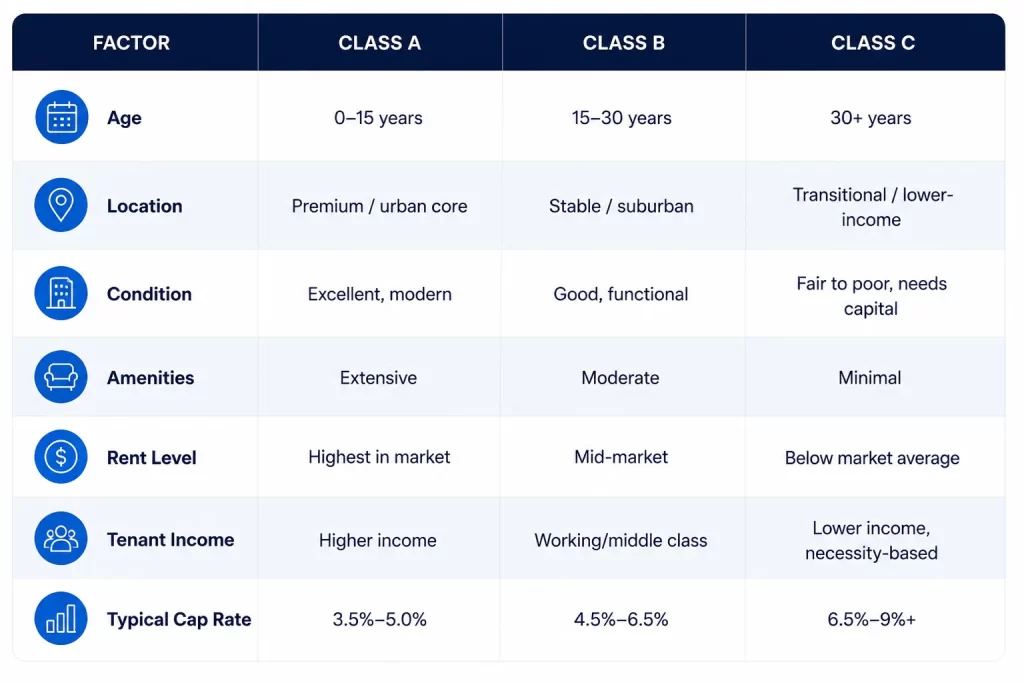
Two appraisers or brokers might classify the same property slightly differently — a well-renovated 25-year-old property in a great location might be considered “B+” while a poorly maintained 15-year-old property in a declining area might be labeled “C+.” The classification system is directional, not precise.
Why Class B and C Properties Often Outperform for Investors
While Class A properties offer the lowest risk and the most prestige, many experienced multifamily investors — including Northwind — focus on Class B and C assets because of several structural advantages:
1. Higher cap rates mean more income per dollar invested. Class B and C properties trade at meaningfully higher cap rates than Class A — often 100 to 250 basis points higher — which translates directly into stronger day-one cash flow for investors.
2. Larger, more resilient tenant pools. Class A apartments depend on a narrower band of high-income renters who can afford premium rents — a pool that shrinks during economic downturns as tenants trade down. Class B and C properties serve the much larger population of working and middle-class renters whose housing need does not disappear in a recession.
3. Significant value-add potential. Class A properties are typically already optimized — there is limited room to increase rents or improve operations beyond what’s already in place. Class B and C properties frequently have below-market rents, deferred maintenance, and operational inefficiencies that a skilled operator can address, creating forced appreciation that Class A assets simply cannot offer to the same degree.
4. Reduced new supply competition. Most new construction targets the Class A tier, since new buildings are, by definition, the newest and highest-quality stock in a market. This means Class B and C properties face less direct competition from newly delivered supply — a meaningful advantage in markets experiencing a wave of Class A apartment construction.
5. More favorable risk-adjusted return profile. When you account for the combination of higher entry yields, value-add upside, and tenant base resilience, well-located and well-managed Class B properties in particular often deliver superior risk-adjusted returns compared to Class A — without taking on the operational intensity that comes with Class C or D assets.
For a deeper, side-by-side breakdown of how Class B and Class C properties specifically compare on returns, risk, and management demands, see our companion guide, Class B vs. Class C Apartments: Which to Invest In?
The Trade-Offs: What You Give Up Moving Down the Classes
Lower classes are not automatically better — they come with real trade-offs investors should weigh carefully.
Management intensity increases. Class C properties require more hands-on management, more frequent unit turnover, and more capital expenditure oversight than Class A or B assets.
Financing becomes more limited. Class A and B properties qualify more easily for favorable agency financing (Fannie Mae and Freddie Mac), while Class C properties — particularly distressed ones — often require bridge loans or private financing at higher rates.
Exit liquidity narrows. Class A properties attract the broadest buyer pool, including large institutional capital. Class C properties have a smaller pool of qualified buyers, which can affect pricing and timing at exit.
Execution risk rises. The forced appreciation upside in Class B and C properties only materializes if the business plan is executed well. A renovation program that runs over budget, or a lease-up that takes longer than projected, can erode the very advantage that made the lower-class asset attractive in the first place.
How Northwind Approaches Property Class Selection
At Northwind Investment Group, our primary focus is Class B multifamily properties — and select, well-located Class C assets — in high-growth Florida, Texas, and Southeast markets. We believe this segment offers the most attractive combination of stable tenant demand, meaningful value-add potential, and disciplined risk management for our investor partners.
We avoid Class D assets entirely, given the operational and reputational risk involved, and we are selective about Class C investments — focusing only on properties in markets with strong underlying fundamentals and a clear, executable path to NOI growth.
Frequently Asked Questions
What is the difference between Class A, B, and C real estate? Class A properties are the newest, highest-quality assets with premium amenities and the highest rents. Class B properties are well-maintained, mid-tier assets typically 15–30 years old, serving working and middle-class tenants. Class C properties are older, 30+ years old, often requiring capital investment, and serving lower-income, necessity-based renters. Each class carries a different risk, return, and management profile.
Which real estate class has the best returns? Class C properties typically offer the highest cap rates and potential cash yields, but they carry the most risk and management intensity. Class B properties often deliver the best risk-adjusted returns — combining meaningful value-add upside with a more stable, diversified tenant base and easier access to favorable financing than Class C.
Is Class B real estate a good investment? Class B real estate is widely considered an attractive investment because it offers a balance of stable cash flow, accessible financing through agency lenders, a deep and resilient tenant pool, and significant value-add potential through renovation and operational improvement — without the elevated management intensity associated with Class C properties.
How do I know what class a property is? Property class is determined by evaluating several factors together: age, location quality, physical condition, amenities, rent levels relative to the market, and tenant income profile. There is no official certification — classification is based on market convention and is often assigned by appraisers, brokers, and lenders using comparable judgment.
Can a property change classes over time? Yes. A Class B property that receives significant renovation and repositioning can be upgraded to “B+” or even Class A status in the eyes of the market. Conversely, a Class A property that ages without reinvestment can gradually be perceived as Class B as newer competitive supply enters the market. This dynamic is part of what creates value-add opportunity in real estate.
Does Class A real estate ever underperform Class B or C? Yes, particularly during periods of oversupply. When a market experiences a wave of new Class A apartment construction, existing Class A properties can face rent pressure and elevated concessions to maintain occupancy, since they are competing directly with newer product. Class B and C properties, serving a different tenant base with fewer new competitive options, are often more insulated from this specific risk.
Explore Class B Multifamily Opportunities With Northwind
Understanding real estate classes is the foundation for evaluating any property or deal. If you’re ready to see how this plays out in real investment opportunities, explore what Northwind is currently offering.