
Industrial real estate has become one of the most discussed asset classes in commercial real estate over the past decade — driven by e-commerce growth, supply chain reshoring, and a structural shortage of modern logistics space. For investors building a real estate portfolio, understanding industrial real estate is useful even if your primary allocation sits elsewhere. This guide explains what industrial real estate is, the trends driving demand, the return profile investors can expect, and how it compares to multifamily — Northwind’s primary area of focus.
What Is Industrial Real Estate?
Industrial real estate refers to properties used for manufacturing, production, storage, distribution, and logistics — including warehouses, distribution centers, manufacturing facilities, flex space, and data centers. Unlike multifamily or office properties, industrial assets are typically leased to businesses rather than individual tenants, often on long-term leases of 5 to 15 years.
Industrial real estate is generally divided into several subtypes, each with distinct tenant profiles and lease structures.
Types of Industrial Real Estate Assets
| Asset Type | Description | Typical Lease Length |
|---|---|---|
| Warehouse / Distribution | Storage and distribution of goods, often near transportation hubs | 5–10 years |
| Last-Mile Logistics | Smaller facilities near urban centers for fast delivery (e-commerce fulfillment) | 5–7 years |
| Manufacturing | Facilities used for production of goods | 10–15+ years |
| Flex / R&D Space | Combination of office, warehouse, and light industrial use | 3–7 years |
| Cold Storage | Temperature-controlled facilities for food and pharmaceutical storage | 10–20 years |
| Data Centers | Specialized facilities housing computing infrastructure | 10–20 years |
Key Trends Driving Industrial Real Estate Demand
E-commerce growth. Online retail now represents roughly 16% of total U.S. retail sales, according to U.S. Census Bureau data, up from under 6% in 2012. Every incremental shift to e-commerce requires significantly more warehouse and distribution space than traditional retail — industry estimates suggest e-commerce requires roughly three times the logistics square footage per dollar of sales compared to brick-and-mortar retail.
Supply chain reshoring. Following pandemic-era supply chain disruptions, many manufacturers have relocated or diversified production closer to U.S. and North American markets — a trend often called “nearshoring” or “reshoring.” This has driven demand for domestic manufacturing and warehouse space, particularly along the U.S.-Mexico border and in the Southeast.
Limited new supply in infill locations. Land suitable for large industrial development near major population centers is increasingly scarce, particularly for last-mile logistics facilities that need to be close to dense consumer populations. This scarcity supports rent growth in well-located industrial submarkets.
Rising construction costs. Higher costs for steel, concrete, and labor have slowed new industrial development since 2022, helping keep vacancy rates low in many markets despite a wave of deliveries completed in 2021–2023.
Industrial Real Estate Investment Metrics & Returns
Industrial real estate has historically delivered strong risk-adjusted returns, supported by long-term leases and stable tenant demand. Typical metrics include:
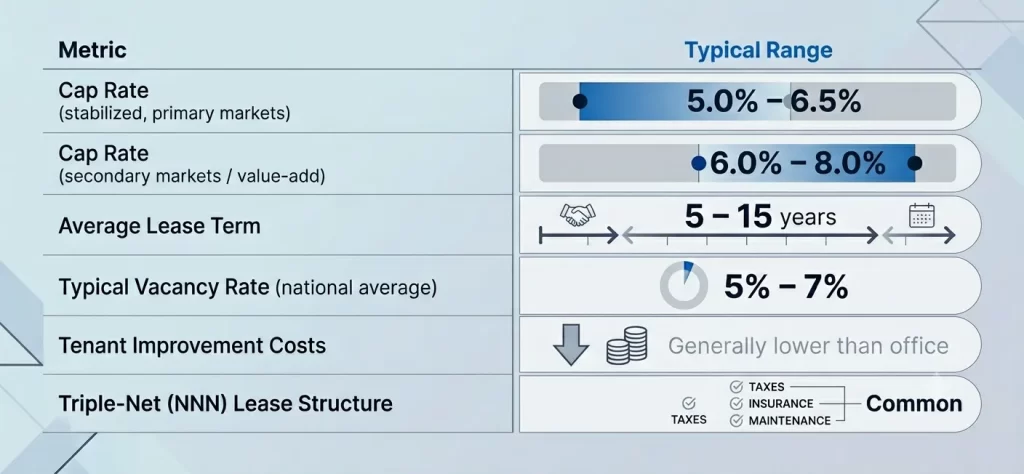
The triple-net lease structure common in industrial real estate is a meaningful advantage: tenants are typically responsible for property taxes, insurance, and maintenance costs, which simplifies the landlord’s expense exposure compared to multifamily, where the owner bears most operating costs directly.
Industrial Real Estate vs. Multifamily: Side-by-Side Comparison
| Factor | Industrial Real Estate | Multifamily Real Estate |
|---|---|---|
| Tenant Type | Businesses (corporate tenants) | Individuals and families |
| Lease Length | 5–15+ years | 12 months (typical) |
| Lease Structure | Often triple-net (tenant pays expenses) | Gross lease (landlord pays expenses) |
| Income Predictability | High — long leases, low turnover High | Moderate — frequent renewals, seasonal demand shifts Moderate |
| Recession Resilience | Moderate — tied to consumer spending and trade Moderate | High — housing is a non-discretionary need High |
| Management Intensity | Low — fewer tenants, longer leases Low | Moderate to high — frequent turnover, day-to-day operations Moderate–High |
| Re-leasing Risk | Concentrated — losing one tenant can mean major vacancy | Diversified — many units reduce single-tenant risk |
| Demand Driver | E-commerce, trade, manufacturing | Population growth, housing shortage, household formation |
| Typical Hold Period | 5–10 years | 3–7 years |
| Value-Add Potential | Lower — limited renovation upside Low | Higher — unit renovations directly drive rent growth High |
| Accessibility for Passive Investors | Fewer syndication options; more institutional | Widely available through syndications |
Why Tenant Concentration Matters in Industrial Real Estate
One of the most important risk factors in industrial real estate is tenant concentration. A typical 150,000-square-foot distribution center may have just one or two tenants. If that tenant vacates, downsizes, or defaults, the property can sit partially or fully vacant for months while a new tenant is secured — and re-leasing large industrial space often requires significant capital for tenant improvements and broker commissions.
By contrast, a 200-unit multifamily property has 200 separate leases. The loss of any single tenant has a negligible impact on overall occupancy and cash flow. This diversification of tenant risk is one of the core reasons workforce housing multifamily is considered one of the most recession-resilient asset classes in commercial real estate.
Risks of Industrial Real Estate Investing
E-commerce growth deceleration. While e-commerce penetration has grown steadily, the rate of growth could slow, moderating the pace of new warehouse demand in some markets.
Oversupply in specific submarkets. Several major logistics markets experienced a wave of speculative development between 2021 and 2023. In markets where supply outpaced demand, vacancy rates rose and rent growth slowed significantly.
Tenant concentration risk. As noted above, the loss of a single major tenant can have an outsized impact on cash flow, particularly for smaller industrial properties with few tenants.
Trade policy sensitivity. Industrial demand, particularly for cross-border logistics and manufacturing facilities, can be affected by changes in tariffs, trade agreements, and international trade volumes.
Obsolescence risk. Older industrial buildings with lower clear heights, insufficient loading docks, or outdated layouts can struggle to compete with modern, purpose-built logistics facilities — creating a bifurcated market between “Class A” logistics assets and aging, harder-to-lease industrial stock.
Why Northwind Focuses on Multifamily Over Industrial
Industrial real estate is a legitimate and historically strong-performing asset class — and many institutional portfolios benefit from exposure to it. At Northwind Investment Group, however, our primary focus remains Class B and C multifamily real estate in high-growth Southeast and Texas markets, for several specific reasons aligned with our mission of accessible, resilient wealth building:
Diversified income streams. A multifamily property with 100+ units generates income from 100+ separate households. An industrial property may depend on one or two corporate tenants. We prioritize the risk diversification that comes from a broad renter base.
Non-discretionary demand. Housing is a basic need regardless of economic conditions. Industrial demand, while structurally strong, is more closely tied to consumer spending, trade volumes, and corporate capital expenditure decisions — all of which can contract during a recession.
Greater value-add control. In multifamily, we can directly drive NOI growth through unit renovations, improved management, and amenity upgrades — creating forced appreciation. Industrial value-add opportunities are more limited once a building is constructed, since the value is driven primarily by lease terms and tenant credit rather than physical improvements.
Alignment with our mission. Multifamily housing — particularly workforce housing — sits at the intersection of strong investor returns and genuine community impact. It is where we believe Northwind can deliver the most value to both our investors and the residents who call our properties home.

Frequently Asked Questions
Is industrial real estate a good investment? Industrial real estate has historically delivered strong, stable returns driven by e-commerce growth, long-term leases, and limited new supply in well-located markets. It can be a valuable addition to a diversified commercial real estate portfolio, though it carries different risks than multifamily — particularly tenant concentration and sensitivity to trade and manufacturing cycles.
What is the difference between industrial and multifamily real estate? Industrial real estate is leased to businesses for manufacturing, storage, and distribution, typically on long-term triple-net leases. Multifamily real estate is leased to individual households on shorter-term leases, with the landlord responsible for most operating expenses. Multifamily offers greater tenant diversification and is generally more recession-resilient, since housing demand is non-discretionary.
What is driving industrial real estate demand? The primary drivers of industrial real estate demand are e-commerce growth, supply chain reshoring to North America, scarcity of well-located infill land for last-mile logistics, and rising construction costs that have slowed new development. These factors have combined to keep industrial vacancy rates relatively low in most major markets.
What cap rate should I expect for industrial real estate? Stabilized industrial properties in primary markets typically trade at cap rates of 5.0%–6.5%, while value-add or secondary-market industrial assets trade at 6.0%–8.0%. Cap rates vary significantly by submarket, tenant credit quality, lease term remaining, and building specifications such as clear height and loading capacity.
Can passive investors access industrial real estate deals? Passive investment opportunities in industrial real estate exist but are less common than multifamily syndications, and they tend to be concentrated among larger institutional sponsors and private equity real estate funds. Multifamily remains significantly more accessible for everyday accredited investors through syndications and crowdfunding platforms.
Is industrial or multifamily real estate more recession-resistant? Multifamily real estate is generally considered more recession-resistant than industrial because housing is a non-discretionary need — people need a place to live regardless of economic conditions. Industrial demand is more closely tied to consumer spending, trade volumes, and corporate investment decisions, all of which tend to contract more sharply during recessions.
Build Your Portfolio With Northwind’s Multifamily Expertise
While industrial real estate has its place in a diversified portfolio, Northwind’s expertise and focus remain in Class B and C multifamily — where diversified tenant demand, non-discretionary housing need, and direct value-add control combine to create durable, risk-adjusted returns for our investors.
- Explore active multifamily opportunities: portal.northwindig.com
- Learn why we focus on multifamily: northwindig.com/investment-strategy/why-multifamily
- Read more investor insights: northwindig.com/insights
- Speak with our team: (888) 842-0476
Real assets. Real returns.