

IRR meaning, in real estate, refers to the annualized rate of return on an investment that accounts for the size and timing of every cash flow over the entire hold period — from the day you invest to the day the asset is sold. It is one of the two most important return metrics in private real estate investing, alongside MOIC, and it appears in virtually every deal summary, offering memorandum, and investor pitch deck you will encounter.
Understanding what IRR means — and what it does not mean — is essential for evaluating whether a deal is priced appropriately for its risk, comparing opportunities side by side, and holding sponsors accountable for the projections they put in front of you.
What Is IRR?
IRR (Internal Rate of Return) is the annualized percentage return on an investment that makes the net present value (NPV) of all cash flows equal to zero. In plain language: it is the rate at which your invested capital is growing each year, on average, after accounting for exactly when you receive money back.
Unlike simple annual return calculations, IRR weights the timing of cash flows. Money received sooner is worth more than the same amount received later — and IRR captures that difference precisely.
In real estate, the cash flows that go into an IRR calculation include:
- Your initial equity investment (a negative cash flow, since it leaves your pocket)
- Quarterly or annual distributions received during the hold period
- Any refinance proceeds returned to investors mid-hold
- Net sale proceeds received when the property is sold
How Is IRR Calculated?
IRR is calculated by solving for the discount rate that sets the net present value of all cash flows to zero. The mathematical formula is expressed as:
0 = CF₀ + CF₁/(1+IRR)¹ + CF₂/(1+IRR)² + … + CFₙ/(1+IRR)ⁿ
Where:
- CF₀ = initial investment (negative value)
- CF₁, CF₂… CFₙ = cash flows received in each period
- n = number of periods
- IRR = the rate being solved for
In practice, IRR cannot be solved with a simple algebraic formula — it requires iterative calculation. Sponsors use Excel (the IRR or XIRR function), financial modeling software, or purpose-built underwriting tools to compute it. As a passive investor, you do not need to calculate it yourself — but you do need to understand what the number means and what assumptions drive it.
A Simple IRR Example in Real Estate
Here is a straightforward example of how IRR works in a multifamily syndication:
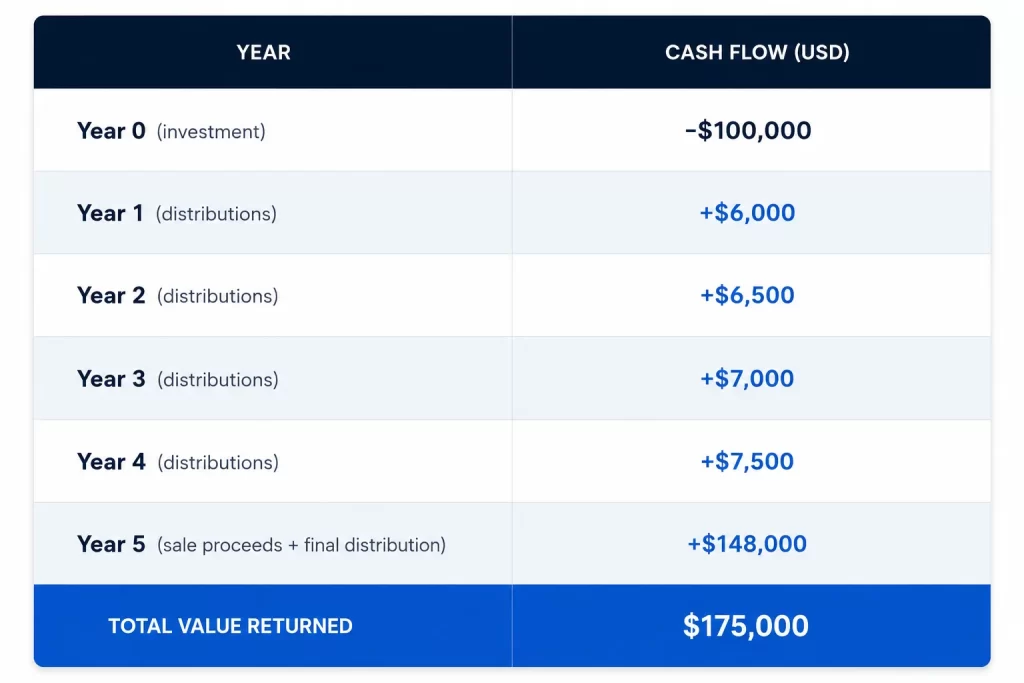
In this scenario:
- MOIC = $175,000 ÷ $100,000 = 1.75x (total return)
- IRR ≈ 12.1% (annualized return, accounting for timing)
Notice that the MOIC tells you how much you made — 75% total return. The IRR tells you how fast you made it — 12.1% per year. Both numbers are needed to understand the full picture.
If the same 1.75x MOIC were achieved over 10 years instead of 5, the IRR would drop to approximately 5.8%. Same total return, dramatically different annualized performance.
What Is a Good IRR for Real Estate?
There is no universal answer — IRR benchmarks vary by deal type, risk level, hold period, and market. That said, here are widely used reference ranges for private multifamily real estate:
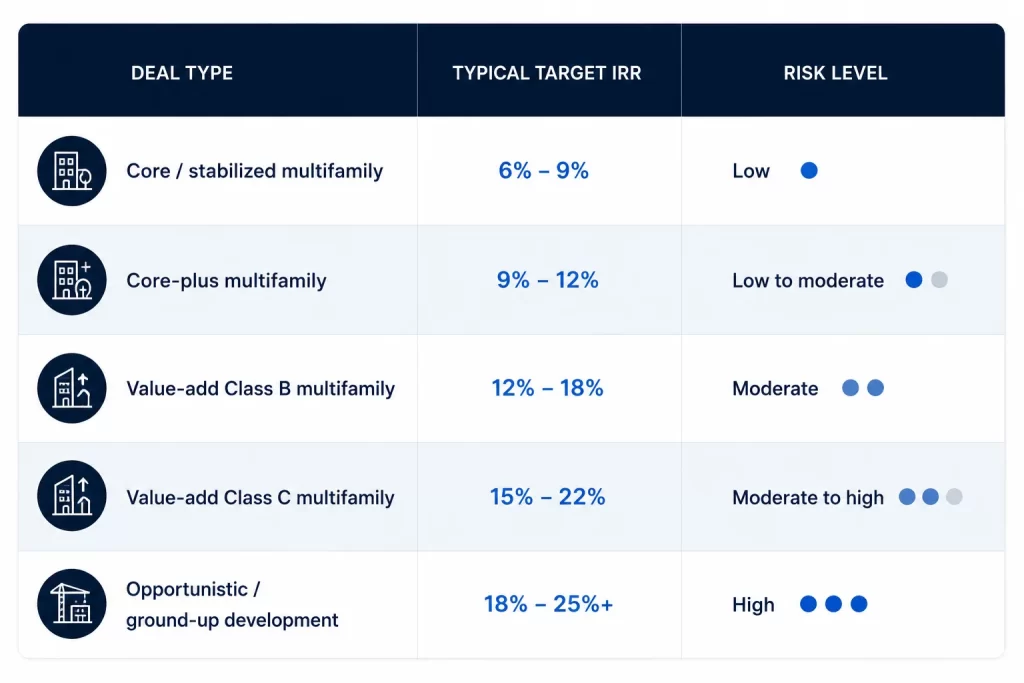
A projected IRR of 15%–18% on a value-add Class B multifamily deal in a high-growth market is generally considered a strong, credible target — provided the underwriting assumptions are conservative and the sponsor has a track record of delivering on similar projections.
Be cautious of projected IRRs above 20% on stabilized or lightly value-add assets. At that level, the projections often rely on aggressive rent growth assumptions, optimistic exit cap rate compression, or leverage that amplifies both upside and downside risk.
IRR vs. MOIC: Why You Need Both
IRR and MOIC are complementary metrics. Using only one gives you an incomplete picture.
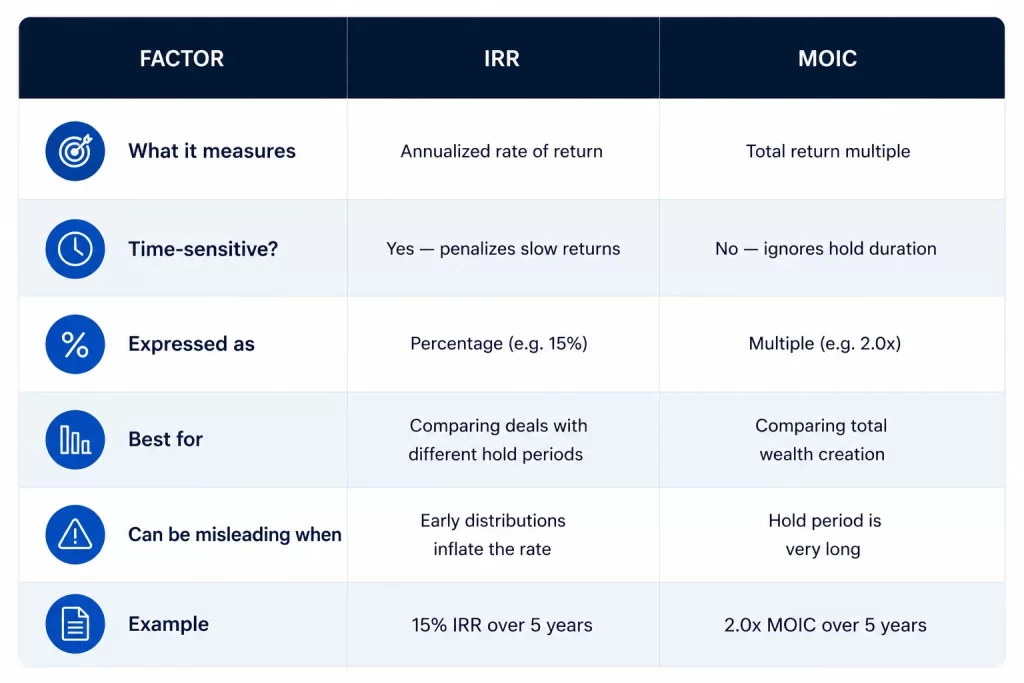
The practical rule: A deal with a strong IRR but a low MOIC may return capital quickly but create less total wealth. A deal with a high MOIC but a low IRR may build wealth slowly. The best deals deliver both — strong annualized returns and meaningful total value creation.
At Northwind Investment Group, our value-add multifamily deals in Florida, Texas, and the Southeast are underwritten to target both metrics — with a typical projection of 15%–18% IRR and a 2.0x–2.2x MOIC over a 4–6 year hold period.
How IRR Is Used in Multifamily Syndications
In a typical multifamily syndication, the sponsor (general partner) presents projected IRR as part of the investment summary. Here is how it flows through the deal structure:
Preferred return: Passive investors (limited partners) typically receive a preferred return of 6%–8% annually before the sponsor receives any profit. This preferred return is factored into the IRR calculation as interim cash flows.
Waterfall structure: After the preferred return is paid, profits are split between LPs and the GP according to a waterfall — often 70/30 or 80/20 in favor of LPs. The IRR at which this split changes is called the “IRR hurdle.” A typical structure might promote the GP to a 30% or 50% share of profits once investors have achieved a 12% or 15% IRR.
What this means for you: The waterfall aligns the sponsor’s incentives with yours. The sponsor only captures outsized profit after you have achieved a meaningful return — which is why IRR hurdles matter and why you should always ask what the promote structure looks like at different IRR thresholds.
What IRR Does Not Tell You
IRR is a powerful tool, but it has well-documented limitations every serious investor should understand.
It does not account for reinvestment risk. IRR implicitly assumes that interim distributions are reinvested at the same rate as the IRR itself — which is almost never realistic. The Modified Internal Rate of Return (MIRR) addresses this, though it is less commonly cited in real estate deal summaries.
It can be manipulated by the timing of distributions. A sponsor who returns a large portion of capital early — through a refinance, for example — will inflate the IRR even if total returns are moderate. Always check MOIC alongside IRR to see whether the total value creation is consistent with the annualized rate.
It is a projection, not a guarantee. Projected IRR is only as reliable as the assumptions behind it. The two assumptions that most dramatically affect projected IRR in real estate are rent growth rate and exit cap rate. Ask sponsors to show you their assumptions and stress-test scenarios — what happens to IRR if rents grow 2% instead of 5%, or if the exit cap rate is 50 basis points higher than projected?
It does not reflect taxes. IRR is a pre-tax metric. Real estate investments do offer significant tax advantages — depreciation pass-throughs, cost segregation studies, and potential 1031 exchange treatment — but these do not appear in the IRR figure. Your after-tax return will depend on your individual tax situation.
It does not capture deal-level risk. A 16% projected IRR in a stabilized, well-located Class B property is not the same risk as a 16% projected IRR in a distressed asset in a declining market. Evaluate the business plan, the market, the debt structure, and the sponsor’s track record — not just the number.
Frequently Asked Questions
What does IRR mean in real estate? IRR, or Internal Rate of Return, is the annualized percentage return on a real estate investment that accounts for the size and timing of all cash flows — initial investment, ongoing distributions, and sale proceeds. It answers the question: “At what annual rate is my money growing in this deal?”
What is a good IRR for a real estate syndication? For a value-add multifamily syndication, a projected IRR of 13%–18% is generally considered a strong and credible target range, depending on market conditions and the deal’s risk profile. IRRs above 20% on non-development deals warrant scrutiny of the underlying assumptions. IRRs below 10% may not adequately compensate for the illiquidity and risk of private real estate.
What is the difference between IRR and cash-on-cash return? Cash-on-cash return measures only the annual income distributions you receive divided by your invested capital — it does not include appreciation or sale proceeds. IRR measures total return across the entire investment horizon, including distributions and equity at sale. Cash-on-cash is an annual income metric; IRR is a lifetime-of-deal metric.
Why is IRR different from a simple annual return? A simple annual return ignores when you receive money. IRR accounts for the time value of money — $10,000 received in Year 1 is worth more than $10,000 received in Year 5, and IRR reflects that difference. This makes IRR a more accurate measure of true investment performance than a simple annualized calculation.
Can IRR be negative? Yes. If the total value returned to an investor is less than their original investment — due to an operating shortfall, forced sale, or market decline — the IRR will be negative. A negative IRR indicates a loss of invested capital.
How does leverage affect IRR in real estate? Leverage (debt financing) amplifies IRR when a deal performs as projected, because the investor earns returns on a larger asset base while only having invested a portion in equity. However, leverage also amplifies losses if the deal underperforms. Higher leverage generally produces higher projected IRR — but also higher downside risk.
Ready to See Real Projections on Real Deals?
Understanding IRR is one thing. Evaluating it in the context of a specific deal — with conservative underwriting, transparent assumptions, and a sponsor who co-invests alongside you — is another.
At Northwind Investment Group, every investor presentation includes projected IRR, MOIC, cash-on-cash return, and a clear breakdown of the underwriting assumptions driving each number. No black boxes. No speculation. Just data-driven, disciplined underwriting.
- Browse active investment opportunities: portal.northwindig.com
- Understand our investment approach: northwindig.com/investment-strategy/why-multifamily
- Read our investor FAQ: northwindig.com/faq
- Speak with our team: (888) 842-0476
Strategic capital builds real wealth.