

Value add in real estate refers to an investment strategy where an operator acquires an underperforming or under-managed property, executes targeted operational and physical improvements, and captures the resulting increase in value upon refinancing or sale. It is the dominant strategy in institutional multifamily investing — and for good reason: it offers investors a disciplined path to returns that exceed what a stabilized, fully leased property can produce, without requiring the development risk of ground-up construction.
Understanding what value-add means, how returns are generated, and what separates a well-underwritten value-add deal from a speculative one is essential for any passive investor evaluating multifamily syndications.
What Is Value-Add Real Estate?
In commercial real estate, assets are typically categorized along a risk/return spectrum based on how much work they require and how predictable their cash flows are. Value-add sits in the middle of that spectrum — between lower-risk core investments and higher-risk opportunistic plays.
Core assets are stabilized, fully occupied properties in prime locations that require minimal intervention. They offer lower returns but high predictability. Opportunistic assets involve significant development, repositioning, or distress — higher potential returns but substantially greater execution risk. Value-add assets have identified, executable improvement opportunities that an experienced operator can underwrite with reasonable confidence.
In multifamily specifically, value-add properties typically share several characteristics: occupancy rates that are good but not excellent (often 85–94%), rents that are below market due to deferred capital investment or passive management, unit interiors that have not been renovated in one or more renovation cycles, and common areas or amenities that no longer reflect tenant expectations at the current asking rent.
The core thesis is simple: the market is willing to pay more in rent for a better-quality unit. If you can spend $8,000–$12,000 per unit on targeted renovations and increase rents by $150–$200 per month, you have created real, durable value — value that gets capitalized into the property’s worth at exit.
How Value-Add Returns Are Generated
Value-add returns come from two distinct sources: income return (cash flow from operations during the hold period) and appreciation return (the increase in property value captured at exit). Understanding how each works is essential to evaluating a deal.
Forced Appreciation Through NOI Growth
In commercial real estate, a property’s value is determined primarily by its net operating income (NOI) and the capitalization rate (cap rate) at which the market values that income stream. The formula is:
Property Value = NOI ÷ Cap Rate
This means that increasing NOI directly increases property value — regardless of what comparable sales are doing. This is what distinguishes commercial real estate from residential: an operator who increases rents and reduces vacancy does not need to wait for the broader market to appreciate. They force appreciation through operational execution.
A concrete example: a 100-unit apartment community generating $750,000 in annual NOI at a 5.5% cap rate is worth approximately $13.6 million. If a skilled operator can grow NOI to $950,000 through unit upgrades, occupancy improvement, and ancillary income additions — the same 5.5% cap rate now implies a value of approximately $17.3 million. That is $3.7 million in forced appreciation created entirely through operational execution, not market movement.
For a deeper look at how NOI drives property valuation, see our guide to NOI in Real Estate: Definition, Formula & What It Means for Investors.
Cash Flow During the Hold Period
A well-executed value-add deal also generates cash distributions to investors during the hold period — typically 3–7 years. During early phases of a value-add business plan, free cash flow may be modest as capital is deployed into renovations and leased-up units are taken temporarily offline. As renovations complete and rents stabilize at higher levels, distributable cash flow grows.
Investors in value-add syndications typically receive a preferred return (commonly 6–8%) on invested capital before the general partner participates in profits. Total projected returns across the hold period — combining distributions and exit proceeds — commonly target an IRR in the 14–20% range for well-underwritten value-add multifamily deals, though actual outcomes depend heavily on execution quality and exit conditions.
The Value-Add Playbook: What Operators Actually Do
Value-add is not a vague concept — it is an operational system. Experienced multifamily operators have specific, well-defined levers they pull to create value. The most common and impactful include:
Unit Interior Renovations
The highest-ROI value-add lever in most multifamily properties is unit interior renovation. This typically involves upgrading kitchens (new cabinet fronts or full replacement, countertops, appliances), bathrooms (fixtures, vanities, tile), flooring (LVP replacing carpet), and lighting. The capital cost per unit ranges widely — from $6,000 for a cosmetic refresh to $20,000 or more for a full gut renovation — and operators target a rent-premium-to-cost ratio that justifies the spend.
A disciplined operator tracks renovation ROI unit by unit. If spending $10,000 per unit generates a $175/month rent premium, the annual return on that renovation capital is 21% — a compelling use of dollars. If the same spend only generates $80/month, the math no longer works, and the renovation scope should be adjusted.
Renovations are typically phased across the hold period as units turn naturally, minimizing vacancy disruption and cash flow interruption.
Operational Improvements
Many value-add opportunities exist not in the building itself but in how it is managed. Common operational improvements include:
Implementing RUBS (Ratio Utility Billing System) or individually metered utilities, shifting utility costs from the owner to tenants. This reduces operating expenses directly, increasing NOI without raising rents.
Improving collections and reducing bad debt through tighter screening and more consistent lease enforcement. In properties with passive or absentee management, bad debt often runs at 3–5% of potential gross income — well above the 0.5–1.5% achievable with professional management.
Adding ancillary income streams: pet fees, parking charges, storage unit rentals, laundry income, package locker fees, and similar items that are either uncaptured or below-market in the existing operation.
Reducing controllable expenses such as maintenance labor, landscaping, and insurance through vendor renegotiation, preventive maintenance programs, and portfolio leverage if the operator manages multiple assets in the same market.
Common Area and Amenity Upgrades
Modern renters — particularly at Class A and Class B price points — make leasing decisions based on more than just the unit itself. Upgrading common areas such as the leasing office, fitness center, pool deck, dog park, and package room can support higher asking rents across the entire property. These investments are shared across all units, making their per-unit cost efficient relative to the rent impact they support.
Value-Add Risk Factors
Value-add investing is not without risk, and passive investors should understand the key variables that can pressure returns.
Renovation cost overruns. Construction budgets are estimates. Material prices, labor shortages, and unforeseen conditions (lead paint, asbestos, structural issues) can push per-unit costs above projections. Operators who underwrite to tight margins and do not carry contingency reserves are vulnerable.
Lease-up risk. Projecting a $200/month rent premium is not the same as achieving it. If the local market softens between acquisition and renovation completion, demand for upgraded units may not support the underwritten rents. Operators should model downside scenarios, not just base cases.
Floating-rate debt exposure. Many value-add acquisitions are financed with bridge loans — short-term, floating-rate debt that resets with market interest rates. When rates rise sharply, as they did between 2022 and 2024, debt service increases can compress or eliminate distributable cash flow. Operators who used interest rate caps and conservative underwriting during that period fared significantly better than those who did not.
Timing risk. A 3-year business plan that runs into a soft market at exit — lower buyer demand, compressed values — can force either a sale at reduced proceeds or an extended hold. Operators who acquire at the wrong point in a cycle, or with insufficient hold-period flexibility, can see equity returns impaired even when execution was sound.
For more on how debt structures affect risk and returns in multifamily deals, see our guide to Real Estate Debt Funds.
Value-Add vs. Core vs. Opportunistic
Investors evaluating syndication opportunities often encounter these three terms without a clear framework for comparing them. Here is how they differ in practice:
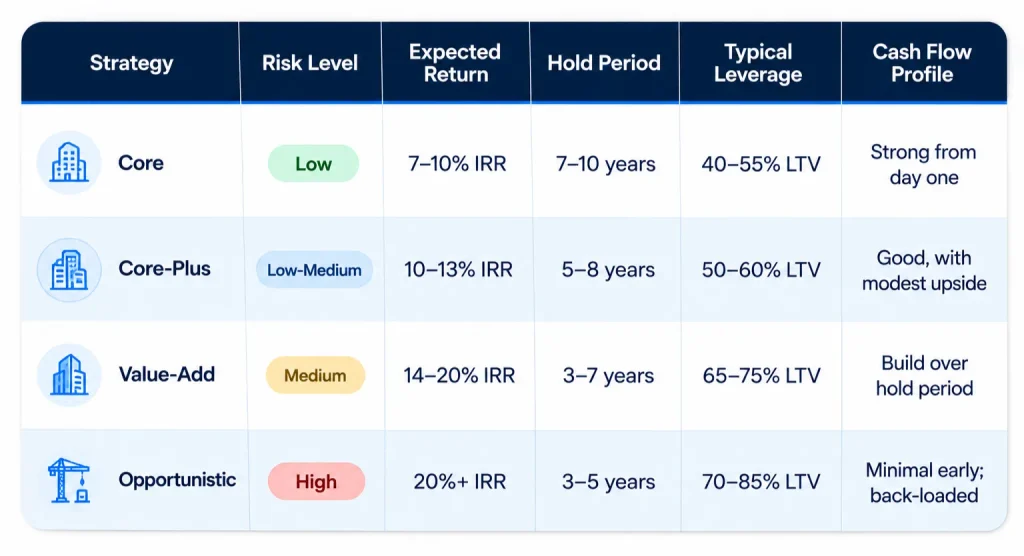
Value-add sits at the intersection of achievable returns and manageable risk — particularly when executed by an operator with deep market knowledge, local vendor relationships, and a track record of completing similar business plans. For passive investors who want meaningful returns without the binary risk of development, it represents the most compelling risk-adjusted entry point in commercial real estate.
For a deeper look at how to evaluate risk-adjusted returns across strategies, see our guide to Risk-Adjusted Returns in Real Estate.
Value-Add in Multifamily: Why This Asset Class?
Value-add can theoretically be applied to any commercial property type — office, retail, industrial, hospitality. But multifamily has consistently attracted the most sophisticated value-add capital, and for good structural reasons.
Demand is demographic, not discretionary. People need housing regardless of economic conditions. While office and retail have faced structural demand headwinds from remote work and e-commerce, multifamily demand is underpinned by population growth, household formation, and persistently constrained supply in most major Sun Belt and urban markets.
Unit-by-unit renovation creates granular risk management. A multifamily value-add business plan does not require shutting down the entire property. Renovations happen unit by unit as leases turn, maintaining income throughout the execution period. This is structurally different from a retail repositioning or office buildout, where large swaths of the building may be vacant simultaneously.
The value-add playbook is well-established. Operators who have executed dozens of multifamily value-add business plans across multiple market cycles have a refined, repeatable system. The variables are well understood, vendor relationships are in place, and comparable renovation costs and rent premiums can be validated against existing comps in the market.
Financing is accessible. Multifamily is the most liquid commercial real estate asset class and benefits from the deepest capital markets, including agency financing through Fannie Mae and Freddie Mac for stabilized exits. Lenders are comfortable with the asset class, which translates to better debt terms and exit optionality for operators.
For more on how multifamily syndications are structured, see our guide to Real Estate Syndication: Meaning, Structure & Returns.
How to Evaluate a Value-Add Opportunity as a Passive Investor
Passive investors reviewing value-add syndication offerings should look beyond projected return figures and examine the underlying assumptions that drive those projections.
Underwritten rent premiums: How much of a rent increase is projected per renovated unit? Is there market evidence (actual leases at comparable renovated properties in the same submarket) supporting those premiums? A $200/month rent increase that cannot be supported by existing comps is not an underwriting assumption — it is a hope.
Current rents vs. market rents: What is the existing rent-to-market ratio? A property at 85% of market rents has clear runway; a property already at 97% of market rents has limited organic upside even before renovations.
Operator track record: Has this operator completed value-add business plans of similar scope and complexity? Do they own or manage other properties in the same market? Local market knowledge matters enormously — vendor relationships, tenant profile understanding, and submarket vacancy dynamics all affect execution.
Debt structure: Is the acquisition financed with floating-rate bridge debt? If so, is there an interest rate cap in place? What is the cap strike rate, and when does it expire? What happens if the business plan takes longer than projected and the bridge loan matures before stabilization?
Exit assumption: At what cap rate is the sponsor projecting to sell? Is that cap rate consistent with the current market? Conservative underwriting assumes exit cap rates equal to or above entry cap rates — not compression.
For a deep dive on how to interpret and compare the financial metrics sponsors present, see our guide to GP vs. LP in Real Estate.
How Northwind Approaches Value-Add Multifamily
At Northwind Investment Group, value-add multifamily is the core of our investment strategy. We acquire Class A and Class B apartment communities in Miami and South Florida where we see clear, executable improvement opportunities — not theoretical upside, but specific, comps-supported rent-premium potential.
Our value-add playbook is built on several principles:
Market depth before acquisition. We underwrite rent premiums against actual executed leases at comparable renovated properties in the same submarket. If renovated units at similar communities within a half-mile radius are not achieving the rents we need, we do not underwrite to them.
Conservative debt structures. For bridge-financed acquisitions, we require interest rate caps and model our business plan across a range of rate scenarios. We prioritize deals where the cash flows remain positive even under stressed assumptions.
Phased renovation execution. We renovate units as they naturally turn, reducing vacancy disruption and maintaining cash flow. We do not force early terminations of occupied units to accelerate the renovation timeline.
Transparent investor communication. We provide investors with quarterly reporting that includes renovation progress, lease-up statistics, and actual-versus-projected performance. When assumptions change, we communicate proactively.
For accredited investors interested in learning more about how we identify and execute on value-add opportunities, we invite you to explore current offerings through the Northwind Investor Portal.
Frequently Asked Questions
What does value-add mean in real estate? Value-add in real estate refers to a strategy where an investor acquires a property that has identifiable improvement opportunities — physical renovations, operational enhancements, or both — and executes on those improvements to increase the property’s income and market value. The term “value-add” distinguishes this approach from core investing (buying stabilized assets) and opportunistic investing (high-risk repositioning or development).
What is a value-add multifamily deal? A value-add multifamily deal is an apartment community acquisition where the business plan involves upgrading unit interiors, improving common areas, and enhancing property management to push rents toward market rate and reduce operating inefficiencies. The goal is to increase NOI during the hold period, forcing appreciation in the property’s value that is captured when the asset is refinanced or sold.
What returns should I expect from a value-add investment? Target returns for value-add multifamily syndications typically fall in the 14–20% IRR range, with equity multiples of 1.5–2.0x over a 3–7 year hold period. These projections are sensitive to renovation execution, rent achievement, debt costs, and exit cap rates. Actual returns can vary significantly from projections depending on how those variables play out.
How is value-add different from opportunistic investing? Value-add investing involves properties with existing cash flow and identifiable, executable improvements. Opportunistic investing involves higher-risk strategies such as ground-up development, major repositioning of distressed assets, or speculative market plays. Opportunistic strategies offer higher projected returns but carry substantially greater execution and market timing risk. Most institutional passive investors are better positioned in value-add, where the business plan is more concrete and the risk variables are better defined.
How long does a value-add business plan take? Most value-add multifamily business plans project a 3–5 year hold period: 12–24 months for renovation and lease-up, followed by a 12–24 month stabilization period that demonstrates sustained cash flow to prospective buyers or lenders before an exit transaction. Some deals execute faster; others require extended holds when market conditions at the projected exit are unfavorable.
Can a passive investor participate in value-add real estate? Yes. The most common structure for passive participation in value-add multifamily is a real estate syndication, where a general partner (the operator) manages acquisition, renovation, and operations while limited partners (passive investors) contribute capital and receive returns in proportion to their ownership stake. Passive investors do not participate in day-to-day decision-making or property management. See our guide to Real Estate Syndication for a full explanation of how syndications work.